 IMAS Metadata Catalogue
Phycology (incl. Marine Grasses)
Type of resources
Topics
Keywords
Contact for the resource
Provided by
Years
-
This dataset is presented as an Excel spreadsheet containing data that were collected and analysed for the project "𝗞𝗶𝗻𝗲𝘁𝗶𝗰𝘀 𝗼𝗳 𝗻𝗶𝘁𝗿𝗮𝘁𝗲 𝗮𝗻𝗱 𝗮𝗺𝗺𝗼𝗻𝗶𝘂𝗺 𝘂𝗽𝘁𝗮𝗸𝗲 𝗯𝘆 𝘀𝗲𝗮𝘄𝗲𝗲𝗱𝘀: 𝗮 𝗴𝗹𝗼𝗯𝗮𝗹 𝗮𝗻𝗮𝗹𝘆𝘀𝗶𝘀” published in 𝘉𝘰𝘵𝘢𝘯𝘪𝘤𝘢 𝘔𝘢𝘳𝘪𝘯𝘢 by Hurd, CL, Lush H, Gannon T and Britton (2027). Data were collected between May 2025 and July 2025 from published studies on the uptake kinetics of nitrate (NO₃⁻) and ammonium (NH₄⁺) by marine macroalgae from the phyla Chlorophyta, Heterokontophyta and Rhodophyta. Articles were identified through searches on Google Scholar and ISI Web of Science. Each study contained data obtained from laboratory experiments on the rate of Dissolved Inorganic Nitrogen (DIN) uptake rate at a range of DIN concentrations. A total of 82 published studies were located, with 532 distinct data entries. Values of the Michaelis-Menten kinetic constants maximum uptake rate (Vmax) and the half saturation constant (Ks) were extracted from studies that reported saturating uptake, and cases where the pattern of uptake with concentration was linear or biphasic were also recorded. For each study, metadata was extracted and recorded that included: taxonomic information (phylum, order, genus and species), functional group using Steneck and Dethier (1994), the experimental subject (species and algal tissue used e.g. apical, basal), habitat of origin (subtidal, intertidal, or cultured), season of collection, and geographic coordinates of the study location (latitude and longitude). Each of the 82 studies in this dataset includes the full reference (author and year) and a functional DOI where available (as of November 2025).
-
This record provides an overview of the scope and research data outputs of the NESP Marine Biodiversity Hub project "Assisting the restoration of seagrasses at Shark Bay". For specific data outputs from this project, please see child records associated with this metadata. -------------------- This project is a collaboration between scientists and the Shark Bay Malgana Indigenous community into jointly developed seeding and shoot planting methods to assist natural recovery of seagrasses in preparation for future devastating impacts of climate change. The Shark Bay World Heritage Site (WHS) is unique globally for its natural values, including stromatolites, seagrass meadows and marine megafauna including dugongs, sharks, turtles, and dolphins. The immediate goal is to scale up the existing restoration research to assist recovery of the dominant seagrasses, Amphibolis antarctica and Posidonia australis following the 2011 marine heat wave. Planned Outputs • A seagrass restoration toolkit (multimedia and report format) - will include information on sourcing suitable genetic material • Data on the trial seed restoration outcomes
-
Out-of-range observations of significant rafts of giant kelp (Macrocystis pyrifera) washing ashore in southern NSW in winter 2020. On 9 August 2020, two local marine naturalists on the south coast of New South Wales, Australia noticed a significant amount of a large unfamiliar kelp washed up on a local beach. Following some quick confirmations via phone and email, it was revealed that the unfamiliar seaweed was giant kelp (Macrocystis pyrifera): a species whose closest known populations are ~450 km away to the south (in Tasmania and western Victoria) and whose transport to New South Wales would have required oceanic rafting over several weeks and hundreds of kilometres against the prevailing south-flowing East Australian Current. Subsequent community-led searches over the following days confirmed four more locations of often-substantial amounts of giant kelp wrack, as well as many more anecdotal and unconfirmed accounts.
-

An aerial survey was conducted for giant kelp (Macrocystis pyrifera) on the east coast of Tasmania from Eddystone Point to Southeast Cape. This survey represents part of a series of similar surveys, with historic aerial surveys having been conducted in 1986 and 1999. The survey was conducted via light aircraft. Areas of visable Macrocystis pyrifera beds were marked on topographical land tenure maps using landmarks as references, and complimentary photo footage was collected.
-

Seagrass beds are a dominant marine ecosystem of Tayaritja (the Furneaux Group of Islands) in the north-eastern waters off Tasmania. Historical coarse mapping has indicated extensive beds of Posidonia, Amphibolis, Heterozostera, and Zostera species, potentially comprising some of the largest and deepest seagrass extents found in temperate Australian waters. However, limited data on the distribution and ecological value of these seagrass habitats represents a significant knowledge gap in understanding Australia's wetland natural assets. This project mapped the extent, ecological composition, population structure, and blue carbon value of seagrass beds around Tayaritja, in partnership with the Tasmanian Aboriginal Centre. This record specifically describes the collection and analysis of epiphyte and mollusc communities associated with seagrass beds. Quadrat-level sampling of seagrass, epiphyte and mollusc community data was undertaken across five subtidal sites in Tayaritja Sea Country in February 2024. At each site, seagrass species, morphology, biomass and cover; epiphyte cover; and mollusc taxon counts, richness, abundance, and diversity metrics were assessed. The dataset provides a baseline for understanding biodiversity values associated with different seagrass species and epiphyte loads in Tayaritja Sea Country. See the "Lineage" section of this record for full methodology. ***EMBARGO NOTE*** Data is currently embargoed until 31/12/2026. Please contact the NESP Data Wrangler (Southern node) to discuss access options: Emma.Flukes@utas.edu.au
-
Most research investigating how ocean warming and acidification will impact marine species has focused on visually dominant species, such as kelps and corals, while ignoring visually cryptic species such as crustose coralline algae (CCA). CCA are important keystone species that provide settlement cues for invertebrate larvae and can be highly sensitive to global ocean change. However, few studies have assessed how CCA respond to low emission scenarios or conditions. In a laboratory experiment, we examined the responses of temperate CCA assemblages to combined warming and acidification projected under low, medium, and high emissions. Net calcification and net photosynthesis significantly declined in all emissions scenarios, while significant reductions in relative growth rates and increases in percentage bleaching were observed in the highest emission scenario. The negative responses of CCA to both low and medium emissions suggest that they may be adversely impacted by combined warming and acidification by 2030 if current emissions are sustained. This will have far reaching consequences for commercially important invertebrates that rely on them to induce settlement of larvae. These findings highlight the need to take rapid action to preserve these critical keystone species and the valuable services they provide.
-
Data were collected from 28 artificial reefs varying in size and supporting different densities of transplanted kelp (Ecklonia radiata). We used rope fibre habitats (RFHs) attached to the benthos of the reefs and destructive sampling of understory algae to collect data on epifaunal invertebrates that naturally colonised the reefs (e.g. secondary productivity, species richness, Shannon diversity). The goal of the research was to understand how kelp structure influences the biodiversity and secondary productivity of epifauna.
-
In coastal ecosystems, seaweeds provide habitat and a food source for a variety of species including herbivores of commercial importance. In these systems seaweeds are the ultimate source of energy with any changes in the seaweeds invariably affecting species of higher trophic levels. Seaweeds are rich sources of nutritionally important compounds such as polyunsaturated fatty acids (PUFA) and are particularly rich in long-chain (≥ C20) PUFA (LC-PUFA). In southern Australia, the ‘Great Southern Reef’ has one of the most diverse assemblages of seaweeds in the world, which support highly productive fisheries and have been recognised as a promising resource of omega-3 LC-PUFA. Despite this, there is little information on the biochemical composition of most species and how it varies between sites and seasons. To address this knowledge gap, we undertook a survey to assess seasonal variability in the biochemical composition (fatty acids and nitrogen content) of abundant understory seaweeds across three sites in eastern Tasmania. The availability of nutritional compounds differed between sites and was primarily driven by differences in the biomass and the biochemical composition of the nutritious red seaweeds at each site. This variability may explain regional differences in the productivity of commercial fisheries. At the species level, seasonal changes in fatty acid composition were highly variable between species and sites, indicating that multiple environmental drivers influence fatty acid composition of seaweeds in this system. This finding suggests that commercial harvest of seaweeds from eastern Tasmania will need to consider species and site-specific variability in fatty acid composition.
-
This record provides an overview of the scope and research data outputs of the NESP Marine Biodiversity Hub project "Assessing the feasibility of restoring giant kelp beds in eastern Tasmania". For specific data outputs from this project, please see child records associated with this metadata. -------------------- This project will extend an externally funded project conducted through UTAS commencing in 2018 to select for thermally tolerant and low-nutrient-tolerant giant kelp (Macrocystis pyrifera) genotypes, and to examine effects of acclimation of selected genotypes by pre-exposure to warm, nutrient-poor conditions. The proposed project will outplant pre-exposed selected genotypes of giant kelp as micro-sporophytes in an experiment with and without provision of an added source of nutrient. The work is designed to assess the feasibility of this approach as a means to develop minimum patch sizes for giant kelp that can be self-replacing and self-expanding, thus providing restoration and future climate-proofing options for this EPBC-listed marine community. Planned Outputs • Experimental data from macrocystis restoration • Final report
-
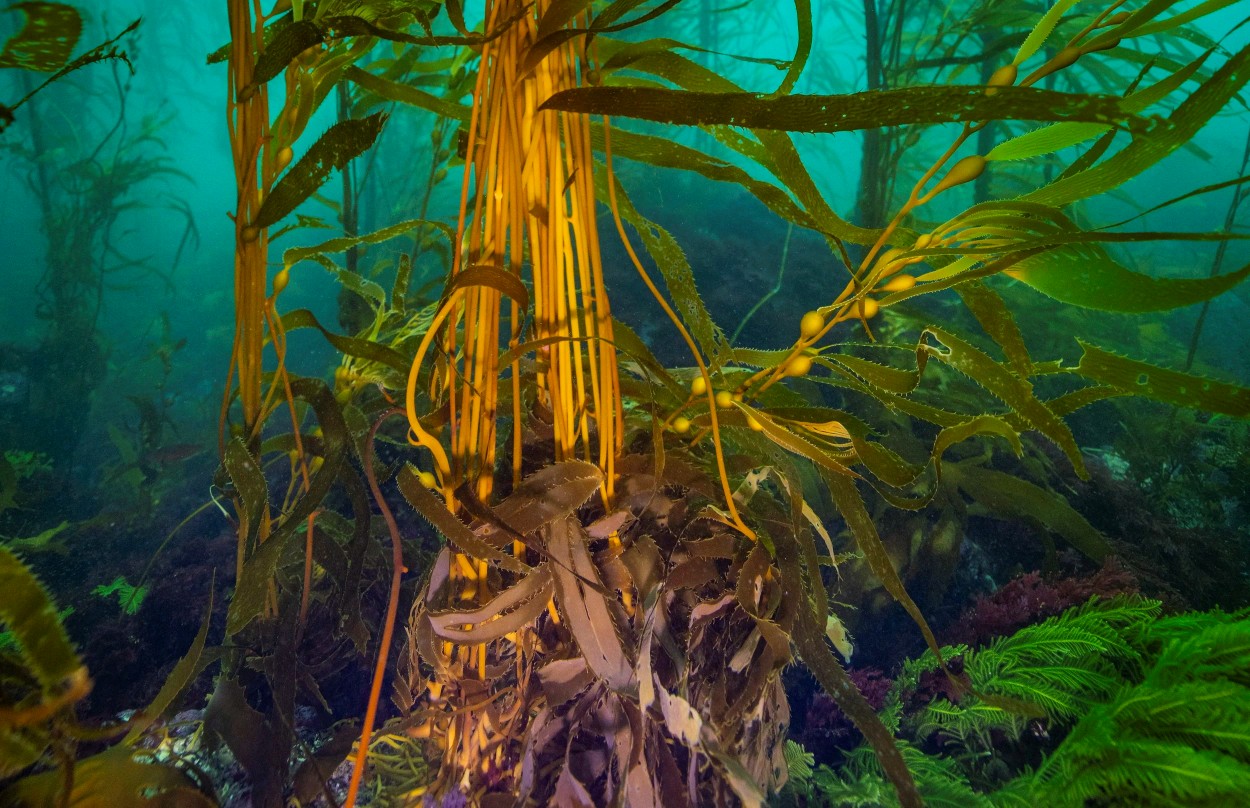
This record described kelp growth and ecophysiological data relevant to the thermal tolerance of specific warm-tolerant and 'normal' family-lines of giant kelp (Macrocystis pyrifera) from Tasmania, Australia. Australia’s giant kelp forests are listed as a Threatened Ecological Community under the Environment Protection and Biodiversity Conservation Act 1999. Habitat restoration is a potential tool for the conservation and management of giant kelp ecosystems. For habitat restoration to be effective, the cause of habitat decline must be understood and overcome. This is problematic when climate change is driving habitat loss since it cannot be reversed or ameliorated prior to restoration. A previous NESP project led by this team (Project E7, Marine Biodiversity Hub) identified warm-tolerant strains of giant kelp from remnant patches in eastern Tasmania, where the species has experienced precipitous declines due to ocean-warming. These strains have high potential to assist with ‘future-proofing’ kelp forest restoration, however it is still unclear what the physiological mechanisms are that provide their improved thermal tolerance. This work cultivated the warm-tolerant strains of giant kelp previously identified, along with giant kelp strains of normal tolerance, at both cool (16 °C) and warm temperatures (20 °C). The juvenile kelp was then harvested, and a suite of physiological traits that may be responsible for their differences in thermal tolerance were examined. These included nutrient usage (carbon and nitrogen content), cellular membrane processes (fatty acid contents), and photosynthesis (PAM fluorometry and photosynthetic pigments). The cultivation trials again illustrated the improved ability of the warm-tolerant strains to develop at stressful warm temperatures relative to normal giant kelp. This work demonstrated for their first time that the improved thermal performance of these strains may extend to the development and fertilisation of the earlier kelp ‘gametophyte’ life-stage. Despite the clear differences in growth between the two test groups, the physiological assessments illustrated a complex pattern of responses, some of which are contrary to expected based on prior knowledge of thermal performance in kelps. Nonetheless, these results indicate that the warm-tolerant strains of giant kelp have a greater capacity to alter the composition of their fatty acids and may be more efficient users of nitrogen (a key nutrient for growth and development). This new information will help inform ongoing kelp breeding and selection programs for future-proofing kelp restoration in Australia and globally. The improved understanding of the physiology of kelp thermal tolerance might also help with identifying individuals and populations of Macrocystis, and other kelps, that may be resilient to (or especially threatened by) ocean warming and climate change.