 IMAS Metadata Catalogue
Dissolved inorganic nitrogen uptake by seaweeds: a global analysis
This dataset is presented as an Excel spreadsheet containing data that were collected and analysed for the project "𝗞𝗶𝗻𝗲𝘁𝗶𝗰𝘀 𝗼𝗳 𝗻𝗶𝘁𝗿𝗮𝘁𝗲 𝗮𝗻𝗱 𝗮𝗺𝗺𝗼𝗻𝗶𝘂𝗺 𝘂𝗽𝘁𝗮𝗸𝗲 𝗯𝘆 𝘀𝗲𝗮𝘄𝗲𝗲𝗱𝘀: 𝗮 𝗴𝗹𝗼𝗯𝗮𝗹 𝗮𝗻𝗮𝗹𝘆𝘀𝗶𝘀” published in 𝘉𝘰𝘵𝘢𝘯𝘪𝘤𝘢 𝘔𝘢𝘳𝘪𝘯𝘢 by Hurd, CL, Lush H, Gannon T and Britton (2027).
Data were collected between May 2025 and July 2025 from published studies on the uptake kinetics of nitrate (NO₃⁻) and ammonium (NH₄⁺) by marine macroalgae from the phyla Chlorophyta, Heterokontophyta and Rhodophyta. Articles were identified through searches on Google Scholar and ISI Web of Science. Each study contained data obtained from laboratory experiments on the rate of Dissolved Inorganic Nitrogen (DIN) uptake rate at a range of DIN concentrations. A total of 82 published studies were located, with 532 distinct data entries.
Values of the Michaelis-Menten kinetic constants maximum uptake rate (Vmax) and the half saturation constant (Ks) were extracted from studies that reported saturating uptake, and cases where the pattern of uptake with concentration was linear or biphasic were also recorded.
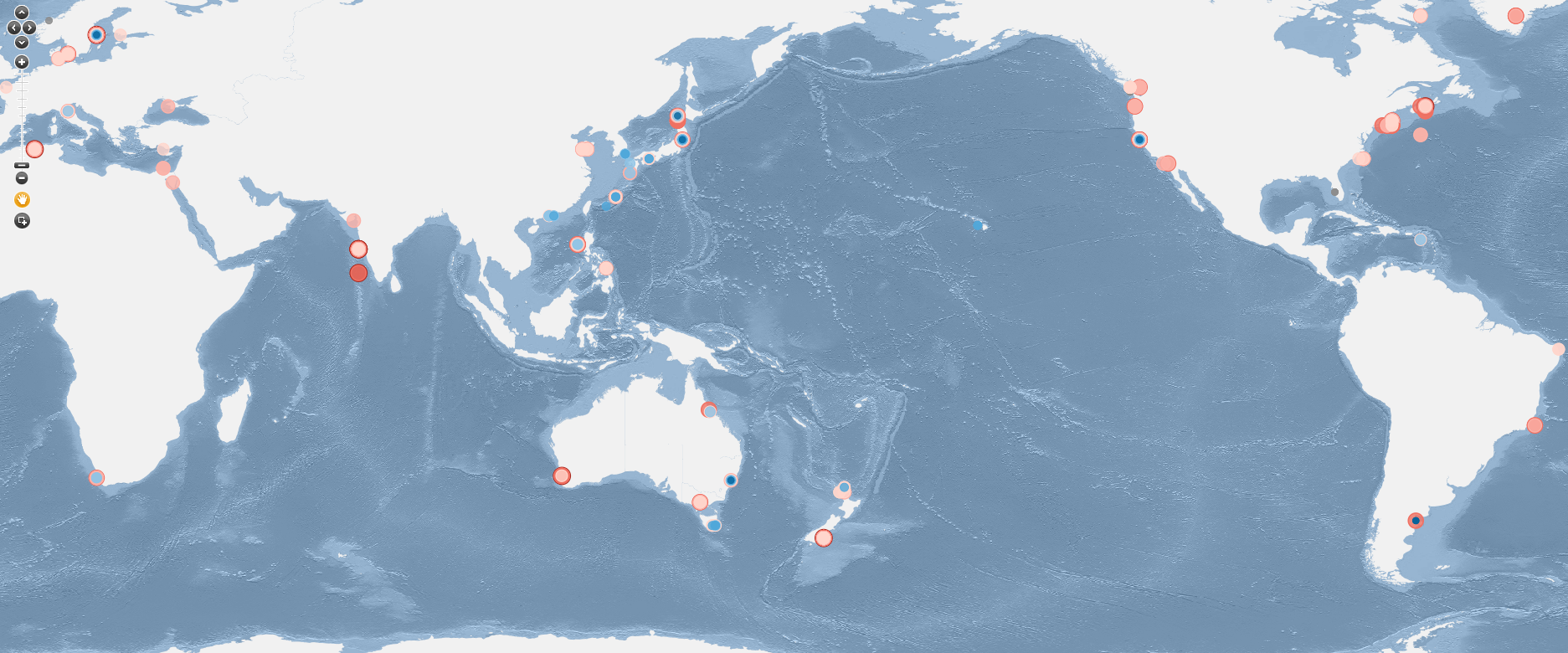
For each study, metadata was extracted and recorded that included: taxonomic information (phylum, order, genus and species), functional group using Steneck and Dethier (1994), the experimental subject (species and algal tissue used e.g. apical, basal), habitat of origin (subtidal, intertidal, or cultured), season of collection, and geographic coordinates of the study location (latitude and longitude).
Each of the 82 studies in this dataset includes the full reference (author and year) and a functional DOI where available (as of November 2025).
Simple
Identification info
- Date (Publication)
- 2025-12-03T00:00:00
Identifier
- Title
- Information and documentation - Digital object identifier system
- Citation identifier
- ISO 26324:2012
- Code
- 10.25959/V2RP-ZA91
- Codespace
- doi.org
- Description
- Digital Object Identifier (DOI)
Principal investigator
Collaborator
Collaborator
Collaborator
- Status
- Completed
Point of contact
Point of contact
- Topic category
-
- Biota
Extent
))
Temporal extent
- Time period
- 2025-05-01 2025-07-01
- Maintenance and update frequency
- Not planned
- Global Change Master Directory Earth Science Keywords, Version 8.5
Resource constraints
- Use limitation
- Data, products and services from IMAS are provided "as is" without any warranty as to fitness for a particular purpose.
Resource constraints
- Linkage
-
https://licensebuttons.net/l/by/4.0/88x31.png
License Graphic
- Title
- Creative Commons Attribution 4.0 International License
- Alternate title
- CC-BY
- Edition
- 4.0
- Website
-
https://creativecommons.org/licenses/by/4.0/
License Text
- Other constraints
- Cite data as: Hurd, C. L., Lush, H. A., Gannon, T., & Britton, D. (2025). Dissolved inorganic nitrogen uptake by seaweeds: a global analysis [Data set]. Institute for Marine and Antarctic Studies. https://doi.org/10.25959/V2RP-ZA91
- Other constraints
- Please also additionally cite the following publication when using this data: Hurd, C. L., Lush, H., Gannon, T., & Britton, D. (2027). Dissolved inorganic nitrogen uptake by seaweeds: a global analysis, Botanica Marina
- Other constraints
- Please contact either Dr Damon Britton or Professor Catriona Hurd prior to using this dataset for publication purposes.
- Language
- English
- Character encoding
- UTF8
Distribution Information
- Distribution format
-
- Microsoft Excel
- OnLine resource
- DATA ACCESS - Macroalgae DIN uptake kinetics
- OnLine resource
-
imas:global_analysis_DINuptake_seaweeds
MAP - DIN uptake rate (Ks) of global seaweeds
- OnLine resource
- Visualise data in the interactive IMAS Data Portal
Resource lineage
- Statement
- Between May 2025 and July 2025, two databases were searched for articles that reported original data on macroalgal uptake rates of nitrate (NO3-) and ammonium (NH4+). The search included articles that reported the Michaelis-Menten kinetic parameters "Vmax" and "Ks (or Km)", or the uptake rate "V" at a given substrate concentration "S". The first database searched was Google Scholar with the search string: "macroalgae" OR "seaweed" OR "kelp" OR "marine plants" AND "nitrate uptake" OR "ammonium uptake" OR "Michaelis-Menten" OR "uptake kinetics" AND "Vmax" OR "Ks" OR "uptake rate". The second database was ISI Web of Science, using the topic field to search two topics simultaneously, following Sheppard et al. (2023): topic 1: ("macro algae" OR "macroalgae" OR "macro-algae" OR "macro algal" OR "macroalgal" OR "macro-algal" OR "kelp" OR "seaweed" OR "marine plants" OR "marine plant" OR "aquatic plants" OR "aquatic plant" OR "macrophyte") and topic 2: ("uptake-kinetics" OR "Vmax" OR "Ks" OR "Km" OR "Vmax/Ks" OR "Vmax/Km" OR "Michaelis-Menten" OR "nitrate" OR "ammonium" OR "nitrate-uptake" OR "ammonium-uptake" OR "saturating" OR "saturating-uptake" OR "linear-uptake" OR "linear" OR "multiple-flask" OR "time-course"). The reference sections of each article found were checked for additional relevant articles. All articles returned in searches that reported Vmax, Ks, linear uptake, and bi-phasic uptake by seaweeds for ammonium or nitrate were included in this review. Older works that reported only curves or slopes without numeric values of Vmax or Ks are also included: here, Vmax and Ks were estimated by printing the published graphs of uptake rate vs concentration and using a fine-scaled ruler to carefully obtain values. For each species in each study for both DIN sources, the pattern of uptake (linear, saturating or bi-phasic) was recorded. For saturating patterns of uptake, values of Vmax, Ks were recorded, and for a linear pattern of uptake, the slope is reported. All values for Vmax and linear uptake rates are reported in units of µmol g-1 (dry weight) h-1 and values for Ks are reported in µmol L-1. In studies where uptake rates were reported per unit wet weight or surface area, conversions to grams dry weight were made by using information provided by the source article, or by conversions provided by other studies where the subject was the same or similar species of seaweed. For example, in Korb and Gerard (2000) Vmax for Laminaria solidungula is reported using surface area, so we used Dunton (1990) who reported conversion factors between surface area and dry weight. Values in the accompanying database are provided in both the original units and on a dry weight basis where conversions were made. The binomial name of each species was checked in AlgaeBase (Guiry and Guiry 2026), and the current taxonomically accepted name applied. The metadata in the Excel spreadsheet includes: each species’ higher taxonomic level (Phylum, Order, Family, and Genus); functional group (using Steneck and Dethier 1994); habitat of origin (intertidal, subtidal, or a laboratory culture); season of collection; the
- Hierarchy level
- Dataset
Metadata
- Metadata identifier
- urn:uuid/3a083248-a4a0-4429-9bef-63e6acbabb14
- Language
- English
- Character encoding
- UTF8
Type of resource
- Resource scope
- Dataset
- Name
- IMAS Dataset level record
- Metadata linkage
-
https://metadata.imas.utas.edu.au/geonetwork/srv/eng/catalog.search#/metadata/3a083248-a4a0-4429-9bef-63e6acbabb14
Point of truth URL of this metadata record
- Date info (Creation)
- 2025-11-24T00:00:00
- Date info (Revision)
- 2026-10-10T11:09:48
Metadata standard
- Title
- ISO 19115-3:2018
Overviews
Spatial extent
Provided by