 IMAS Metadata Catalogue
Brachionichthys hirsutus
Type of resources
Topics
Keywords
Contact for the resource
Provided by
Years
-
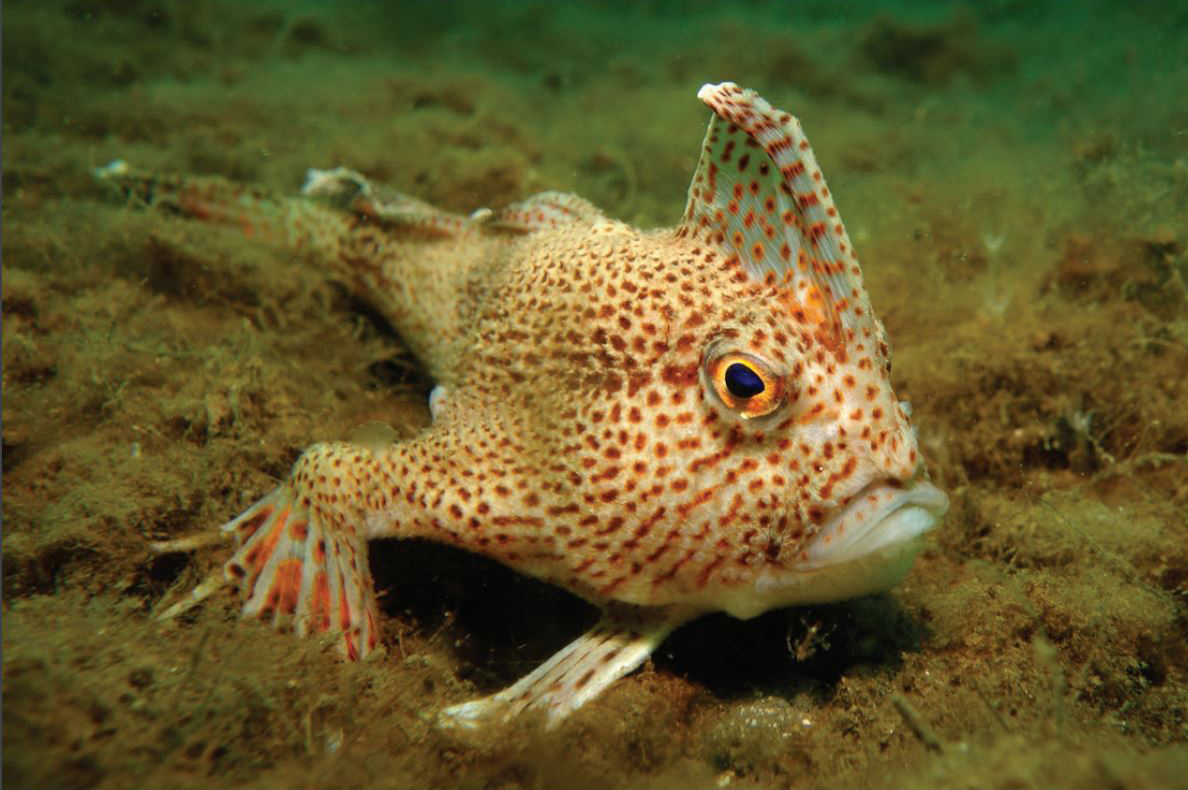
Dive surveys were conducted in 2014 and the same sites resurveyed annually until 2022 (excluding 2021), to establish a baseline and monitor the status of the critically endangered spotted handfish (Brachionichthys hirsutus) population. This dataset is a summary of all surveys season 2014 to 2022 (excluding 2021) in which the 11 sites across the Derwent Estuary and D'Entrecasteaux Channel were assessed. The data describes the search effort (transect length, swathed area) and counts of handfish observed on each transect, including size measurements (total length) and depth records for each sighted fish.
-
Adult and sub-adult Red handfish (Thymichthys politus) and Spotted handfish (Brachionichthys hirsutus) preserved specimens and underwater images were used for analysing morphometrics (comprising of specimens from the CSIRO Australian National Fish Collection and underwater images). Individuals were measured for the morphological traits using electronic callipers (±0.1 mm) for preserved specimens and using Image J software for digital records. Note digital image size calibration occurred using a ruler in images or from size taken in situ. The purpose was to investigate whether external morphometrics could be used to determine sex in handfishes.
-

This record provides an overview of the scope and research output of the NESP Marine Biodiversity Hub project "Conservation of handfish and their habitat". For specific data outputs from this project, please see child records associated with this metadata. -------------------- Spotted Handfish (Brachionichthys hirsutus) and Red Handfish (Thymichthys politus) are Critically Endangered species with small, fragmented populations in southern Tasmania. Spotted Handfish persist only in isolated sub-populations in the Derwent and D’Entrecasteaux estuaries, where recovery is constrained by limited dispersal, specific spawning habitat requirements, degraded habitat, introduced predators, pollution, mooring impacts and coastal development. This project established and extended a monitoring and conservation program for Spotted and Red Handfish in accordance with the Handfish Recovery Plan. For Spotted Handfish, it built on baseline surveys of all known southern Tasmanian sub-populations and applied an innovative georeferenced photographic survey method using towed floats, GPS tracking and individual spot-pattern identification. These data supported density estimates, capture-mark-recapture analysis, assessment of movement between sub-populations, and tracking of conservation actions. From 2019–2020, the project expanded to include Red Handfish and implemented direct conservation actions informed by monitoring and research. Activities included replacement of degraded plastic artificial spawning habitat with redesigned ceramic units, assessment of taut eco-friendly moorings in critical Spotted Handfish habitat, genetic and capture-mark-recapture studies for both species, population viability analysis, and evaluation of management actions. The project also supported captive breeding with industry partners, re-established the Handfish Recovery Team, and contributed to community engagement through talks, outreach and publications. Outputs provided data and evidence to guide artificial spawning habitat placement, brood-stock collection decisions, predator management, mooring replacement, and future recovery planning for both species.