 IMAS Metadata Catalogue
POPULATION DYNAMICS
Type of resources
Topics
Keywords
Contact for the resource
Provided by
Years
-
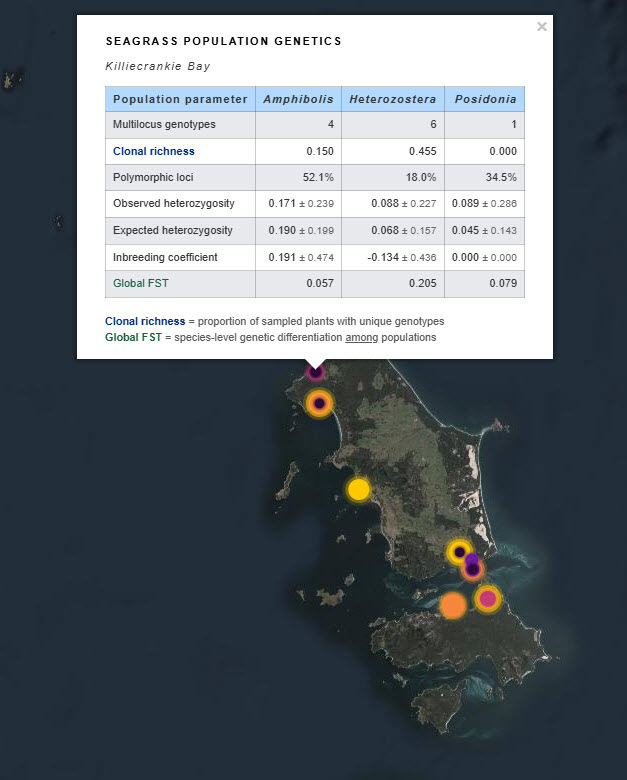
Seagrass beds are a dominant marine ecosystem of Tayaritja (the Furneaux Group of Islands) in the north-eastern waters off Tasmania. Historical coarse mapping has indicated extensive beds of Posidonia, Amphibolis, Heterozostera, and Zostera species, potentially comprising some of the largest and deepest seagrass extents found in temperate Australian waters. However, limited data on the distribution and ecological value of these seagrass habitats represents a significant knowledge gap in understanding Australia's wetland natural assets. This project mapped the extent, ecological composition, population structure, and blue carbon value of seagrass beds around Tayaritja, in partnership with the Tasmanian Aboriginal Centre. This record specifically describes the seagrass population genetics component of the project. Leaf tissue samples were collected from four seagrass species: Amphibolis antarctica, Heterozostera nigricaulis, Posidonia australis and Zostera muelleri. Samples were collected from multiple sites around Tayaritja Sea Country and processed for genome-wide SNP genotyping using the DArTseq platform. The dataset includes population-level genetic summary statistics, associated DArT metadata and reports, and raw sequence data used to support assessment of genetic diversity, clonality, population structure and connectivity among sampled seagrass populations. See the "Lineage" section of this record for full methodology. ***EMBARGO NOTE*** Data is currently embargoed until 31/12/2026. Please contact the NESP Data Wrangler (Southern node) to discuss access options: Emma.Flukes@utas.edu.au
-

Seagrass beds are a dominant marine ecosystem of Tayaritja (the Furneaux Group of Islands) in the north-eastern waters off Tasmania. Historical coarse mapping has indicated extensive beds of Posidonia, Amphibolis, Heterozostera, and Zostera species, potentially comprising some of the largest and deepest seagrass extents found in temperate Australian waters. However, limited data on the distribution and ecological value of these seagrass habitats represents a significant knowledge gap in understanding Australia's wetland natural assets. This project mapped the extent, ecological composition, population structure, and blue carbon value of seagrass beds around Tayaritja, in partnership with the Tasmanian Aboriginal Centre. This record specifically describes the collection and analysis of epiphyte and mollusc communities associated with seagrass beds. Quadrat-level sampling of seagrass, epiphyte and mollusc community data was undertaken across five subtidal sites in Tayaritja Sea Country in February 2024. At each site, seagrass species, morphology, biomass and cover; epiphyte cover; and mollusc taxon counts, richness, abundance, and diversity metrics were assessed. The dataset provides a baseline for understanding biodiversity values associated with different seagrass species and epiphyte loads in Tayaritja Sea Country. See the "Lineage" section of this record for full methodology. ***EMBARGO NOTE*** Data is currently embargoed until 31/12/2026. Please contact the NESP Data Wrangler (Southern node) to discuss access options: Emma.Flukes@utas.edu.au
-

This record provides an overview of the NESP Marine and Coastal Hub project "Updating knowledge of Australian white sharks". For specific data outputs from this project, please see child records associated with this metadata. -------------------- The white shark is listed as Vulnerable and Migratory under Australia’s Environment Protection and Biodiversity Conservation (EPBC) Act 1999. Previous NESP-funded research provided updated estimates of breeding population size and trend, but uncertainty remained around juvenile nursery and pupping areas, movement patterns, and connectivity between eastern and south-western Australian populations. More recent evidence has also raised the possibility of a single Australian population. This project aimed to reduce uncertainty in the status, trends and population structure of white sharks in Australian waters, with a focus on identifying biologically important habitats and improving population assessment through expanded close-kin mark-recapture (CKMR) analyses. The project combined three major components: (1) pilot tagging studies of large adult females and juvenile sharks to improve understanding of movements, pupping areas and habitat use; (2) genetic analyses to assess stock structure and connectivity using samples collected across Australia, and where possible from South Africa and New Zealand; and (3) updated population assessment using expanded tissue sample collections and close-kin mark-recapture methods. Population estimates incorporated approximately 1,000 tissue samples from New South Wales together with additional samples from South Australia and Western Australia. Juvenile abundance information from the New South Wales shark management program was also integrated into the assessment framework. CKMR approaches used genetic identification of parent-offspring and half-sibling relationships to estimate adult abundance, survival and population trends. Project outputs included updated estimates of population size and trend, improved understanding of population connectivity and movement patterns, and refined information on potential nursery and critical habitat areas. These findings support white shark recovery planning, future monitoring design, and conservation assessment in Commonwealth and state waters. Outputs • New genetic samples and sequencing data for white sharks [dataset] • Tracking data from PAT tags [dataset] • Final technical report (including recommendations for systematic future research to assist in identifying additional critical habitat for the south-western white shark population) [written]
-
This database contains acoustic telemetry data for euryhaline elasmobranchs in northern Australian rivers. Data was collected under the National Environmental Research Program (NERP) Marine Biodiversity Hub Project 2.4 'Supporting Management of Listed and Rare Species', and the National Environmental Science Program (NESP) Marine Biodiversity Hub Project A1 'Northern Australian Hotspots for the Recovery of Threatened Euryhaline Elasmobranchs'. An acoustic receiver array was deployed in the Adelaide River, and another in the Alligator Rivers (primarily the South Alligator River) to monitor the movements, habitat use and natural mortality of threatened river sharks (Glyphis species) and sawfishes (Pristis species). Receiver deployment data is available through the IMOS Animal Tracking Facility database (visit https://animaltracking.aodn.org.au/receivers/deployment and search for project 'NESP Northern Australian hotspots for the recovery of threatened euryhaline species'). Raw and processed (cleaned) detection data is attached to this record.
-
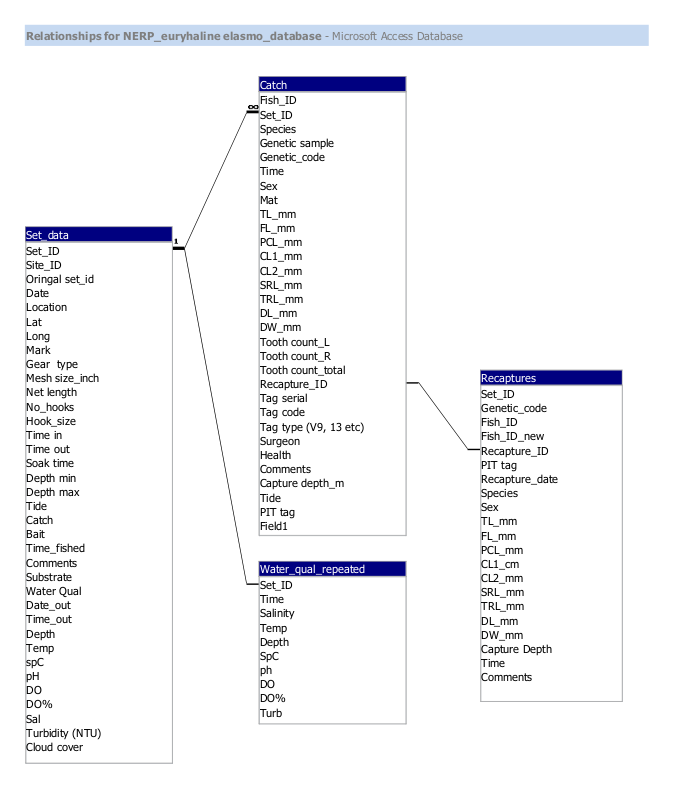
This database contains sampling effort, catch records, biological data, and water quality data for sampling and catches of elasmobranchs in northern Australian rivers, estuaries and coasts undertaken under the National Environmental Research Program (NERP) Marine Biodiversity Hub Project 2.4 'Supporting Management of Listed and Rare Species'. and the National Environmental Science Program (NESP) Marine Biodiversity Hub Project A1 'Northern Australian Hotspots for the Recovery of Threatened Euryhaline Elasmobranchs'. Surveys using gillnets and rod-and-line were undertaken in the Top End region of the Northern Territory and the Kimberley region of Western Australia. Selected animals were tagged for movement ecology, habitat use and mortality estimates (acoustic telemetry), and tissue samples were collected from all fish for molecular analyses (population genetics and close-kin mark-recapture).