 IMAS Metadata Catalogue
offshore renewable energy
Type of resources
Topics
Keywords
Contact for the resource
Provided by
Years
-
This record provides an overview of the NESP Marine and Coastal Hub Research Plan 2023 project "Guiding the sustainable development of offshore renewables and other emerging marine industries in Australia". For specific data outputs from this project, please see child records associated with this metadata. -------------------- Australia is entering a phase of rapid offshore renewable energy development, particularly offshore wind, with priority areas identified across the western, southern and eastern coasts. Regulatory assessment under the EPBC Act and Offshore Electricity Infrastructure Act requires accessible environmental, cultural and monitoring information to support socially and ecologically sustainable development. This project established inventories of existing environmental and cultural data, best-practice monitoring standards, and impact-related literature for continental shelf waters associated with Australia’s six priority offshore wind regions: Hunter and Illawarra, Gippsland, Southern Ocean, Bass Strait, and the Indian Ocean off Bunbury. The process was guided by an Offshore Renewable Energy Program Steering Committee with representatives from DCCEEW, NOPSEMA and Marine and Coastal Hub partners. The work ran in parallel with a related NESP Marine and Coastal Hub project (https://www.nespmarinecoastal.edu.au/project/3-21) focused on the confirmed area of declaration for ORE off the east Gippsland coast, Victoria. Together, both projects were guided by an Offshore Renewable Energy Program Steering Committee comprising representatives from DCCEEW, NOPSEMA and Marine and Coastal Hub partners. Focus areas of the data inventory were: • Seabed geomorphology, bathymetry, sedimentology, and habitat characterisation; • Oceanographic features and coastal processes; • Priority threatened, migratory, and marine species and habitats; • Potential impacts during installation, operation, and decommissioning; • Indigenous communities and cultural values affected by ORE development areas; • Monitoring needs and associated best practices. Project outputs included four database inventories with more than 500 publications across 16 impact types, seabed and oceanographic information, and tabulated summaries and mapped extents of priority species relevant to ORE assessment. The compiled data inventories identified major data and management gaps, including limited high-resolution bathymetry, geomorphology and biological survey data; inconsistent data acquisition standards; limited FAIR access to threatened species data; and the need for coordinated research investment and early Traditional Owner engagement. Outputs from the project will support environmental assessment, mitigation and monitoring of offshore wind impacts, standardisation of data collection methodologies, cumulative impact assessment, and regulatory decision-making under the EPBC and OEI Acts. Outputs • Inventory of existing information and associated sources for the following thematic areas: seabed geomorphology and habitat, oceanography, species and habitats, affected indigenous communities, ongoing monitoring needs and associated best practices, potential impacts of installation and operation [data inventories] • Final project report [written]
-
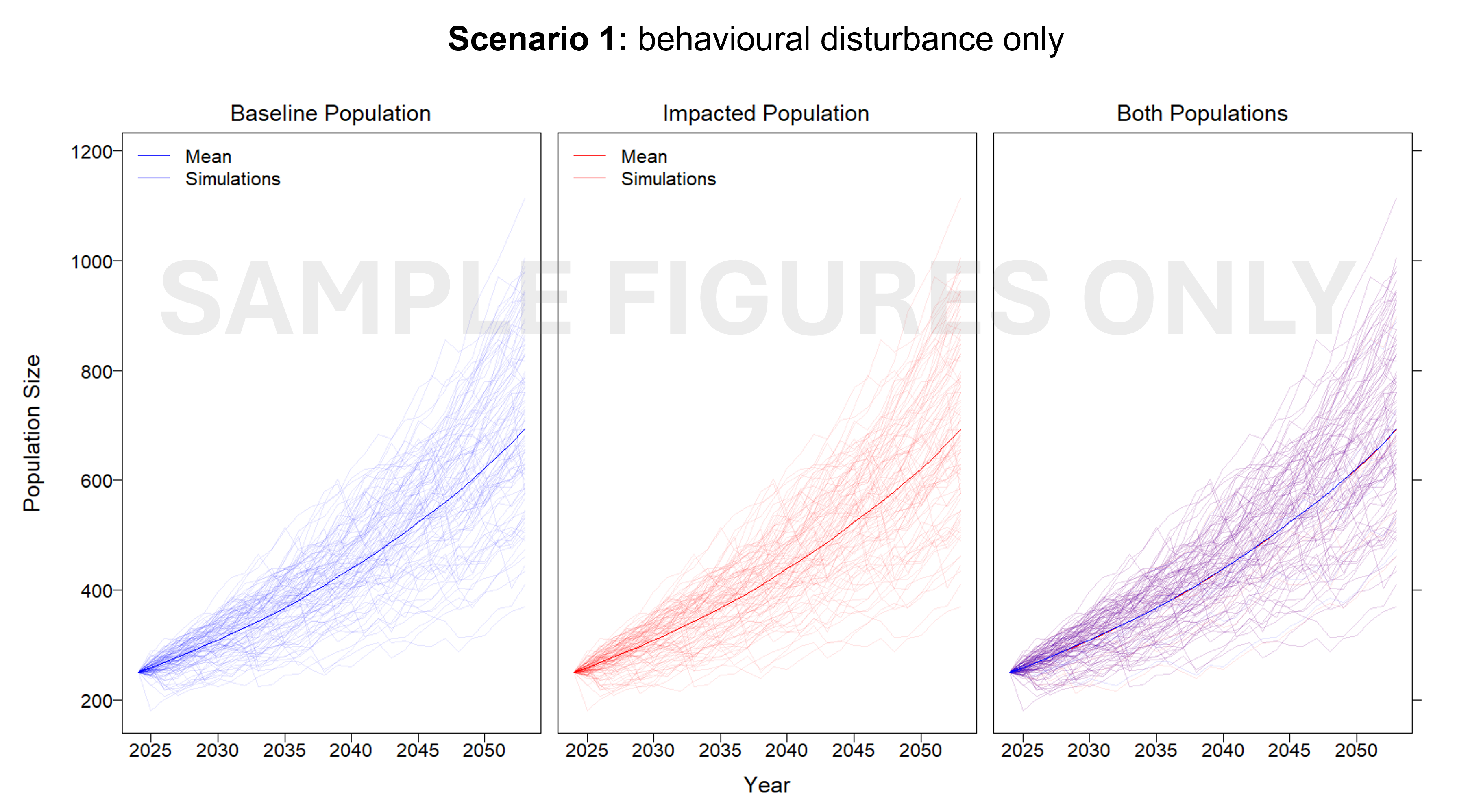
This project developed an interim Population Consequence of Disturbance (iPCoD) model for blue whales (Balaenoptera musculus) and southern right whales (Eubalaena australis) to document a methodology for assessing population-level impacts of one, or multiple, wind farm developments off the southern Australian coast. The iPCoD model was developed in Europe to quantify how disturbances of individuals caused by physiological injury or changes in behaviour can have population-level consequences in data poor marine mammal populations. This model was adapted to suit Australian marine mammal species, highlighting key data gaps for locally threatened populations that overlap in range with the declared offshore wind areas in Australia. Due to the lack of baseline data currently available, this study documented a framework that can be updated as more information becomes available. We outlined how to leverage simulation-based population modelling as a tool for policymakers, industry and management authorities, to aid in environmental impact assessments, with a specific focus on data poor marine mammal populations.