 IMAS Metadata Catalogue
EXTREME WEATHER
Type of resources
Topics
Keywords
Contact for the resource
Provided by
Years
-
This dataset contains processed weather variables, extreme weather indices, to examine the influence of extreme weather events (EWEs) on the reproductive output of three marine predator species in Tasmania: Australian fur seals, short-tailed shearwaters, and shy albatross. The biological data themselves are not included in this submission, as they are owned and managed by the Marine Conservation Program (MCP), Department of Natural Resources and Environment Tasmania, and the Friends of Maatsuyker Island (FOMI, Wildcare Inc.). Weather information was compiled from the Bureau of Meteorology (BOM), the BARRA2 atmospheric reanalysis dataset, and the CAWCR wave hindcast model. Daily summaries and synoptic observations were used to derive meteorological variables relevant to species’ breeding seasons, including temperature, rainfall, wind, solar radiation, wave energy, and derived measures such as wet-bulb globe temperature (WBGT) and apparent temperature (AT). Extreme weather indices were calculated following BOM definitions, using ≥30-year climatological baselines where available. Percentile-based indices were produced in both binary (occurrence) and continuous (magnitude) forms to characterise heatwaves, rainfall extremes, and other EWEs. The purpose of assembling these weather datasets and code is to provide a transparent, reproducible foundation for analysing environmental drivers of reproductive variability across marine predator species in Tasmania. This resource enables users to replicate the workflow used in the associated publication, and statistical analyses linking environmental extremes to breeding outcomes.
-
Globally, terrestrially-breeding marine predators have experienced shifts in species distribution, prey availability, breeding phenology, and population dynamics due to climate change. These central-place foragers are restricted within proximity of their breeding colonies during the breeding season, making them highly susceptible to any changes in both marine and terrestrial environments. While ecologists have developed risk assessments to assess likely climate risk in various contexts, these often overlook critical breeding biology data. To address this knowledge gap, we developed a trait-based risk assessment framework, focusing on the breeding season and applying it to marine predators breeding in parts of Australian territory and Antarctica. Our objectives were to quantify climate change risk, identify specific threats, and establish an adaptable framework. The assessment considered 25 criteria related to three risk components: vulnerability, exposure, and hazard, while accounting for uncertainty. We employed a scoring system that integrated a systematic literature review and expert elicitation for the hazard criteria. Monte Carlo sensitivity analysis was conducted to identify key factors contributing to overall risk. Our results identified shy albatross (Thalassarche cauta), southern rockhopper penguins (Eudyptes chrysocome), Australian fur seals (Arctocephalus pusillus doriferus), and Australian sea lions (Neophoca cinerea) with high climate urgency. Species breeding in lower latitudes as well as certain eared seal, albatross, and penguin species were particularly at risk. Hazard and exposure explained the most variation in relative risk, outweighing vulnerability. Key climate hazards affecting most species include extreme weather events, changes in habitat suitability, and prey availability. We emphasise the need for further research, focusing on at-risk species, and filling knowledge gaps (less-studied hazard criteria, and/or species) to provide a more accurate and robust climate change risk assessment. Our findings offer valuable insights for conservation efforts, given monitoring and implementing climate adaptation strategies for land-dependent marine predators is more feasible during their breeding season.
-
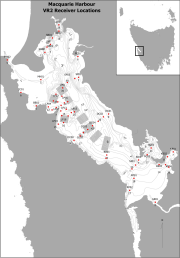
Fixed position oxygen and water temperature logger data from the Macquarie Harbour World Heritage Area (WHA). Two Hobo oxygen data loggers are positioned at approximately 15 m depth at different sites within the WHA, with the intent of monitoring representative mid-bottom water oxygen values in the WHA as these were identified in previous studies to be naturally low due to limited seawater exchange at the harbour entrance, and thus likely to be most susceptible to anthropogenic factors that may increase oxygen demand and alter WHA conservation values. These values include core habitat of the Maugean Skate, a listed threatened species. This work is funded by WHA advisory board via the Nature Conservation Branch of DPIPWE and is part of a larger study being conducted by IMAS undertaking a biological baseline study of the biodiversity of the Macquarie Harbour WHA. This data spans 08/11/14 to present (most recent update 02/02/17).