 IMAS Metadata Catalogue
Department of Primary Industries and Regional Development
Type of resources
Topics
Keywords
Contact for the resource
Provided by
Years
-
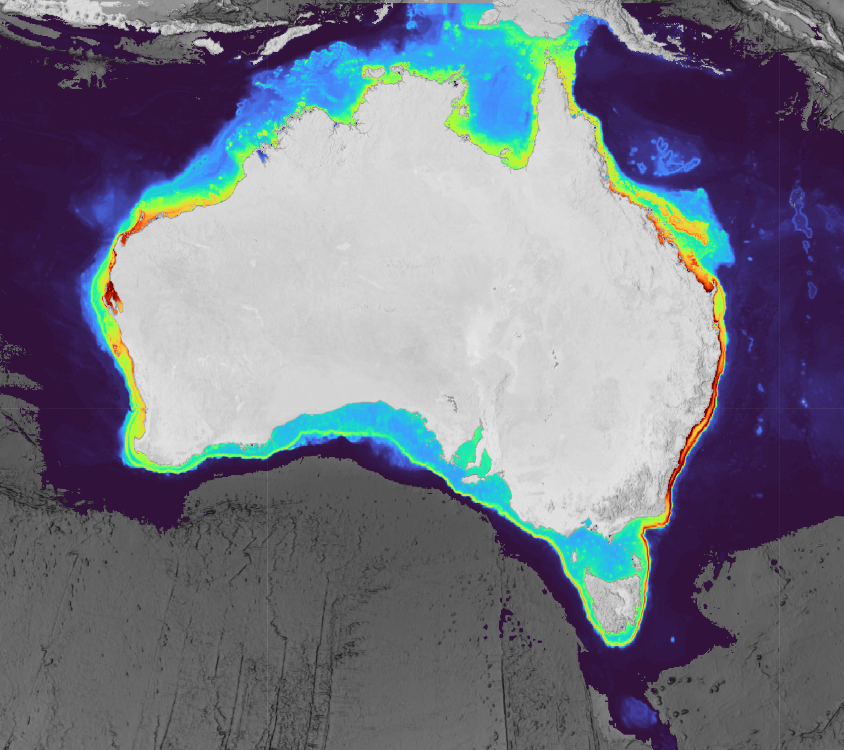
This collection contains predicted range and habitat suitability maps for 220 species of chondrichthyans (sharks, rays, and chimaeras) across Australian waters (7°–49°S, 106°–162°E, excluding offshore territories), representing approximately 68% of Australia's known chondrichthyan fauna. Occurrence records were compiled from 43 heterogeneous data sources, including national and state fisheries observer programs, scientific surveys, biodiversity repositories, acoustic telemetry networks, baited remote underwater video surveys, and beach protection programs, yielding approximately 3.37 million initial records and 2.54 million cleaned records. For all 220 species, an expert validated distribution range surface is provided. For 201 species, two additional habitat suitability prediction layers are included (~5 km resolution), derived at fixed sensitivity thresholds (95% and 90%) representing conservative estimates of the native suitable range. All outputs underwent structured expert review by taxonomic and regional specialists prior to release. Habitat suitability layers were withheld where predictions were judged to reflect sampling artefact rather than ecological signal, regardless of model performance metrics. Users should be aware that even validated suitability layers carry inherent limitations common to presence-only species distribution models at national scales, including residual sampling bias, static environmental predictors, and coarse spatial resolution (~5 km) that cannot resolve fine-scale habitat features relevant to nearshore or habitat-specialist species. These outputs are best interpreted as broad-scale indicators of environmental suitability rather than fine-scale habitat occupancy maps and should be used alongside other lines of evidence in conservation and management applications. A full description of methods, assumptions, and caveats is provided in the associated publication (De Wysiecki et al. in press). This work was funded by the Australian Government through the Parks Australia Our Marine Parks Grant (OMPG4-07), led by the Department of Primary Industries and Regional Development of Western Australia (DPIRD) in collaboration with Curtin University.
-
This record provides an overview of the NESP Marine and Coastal Hub project "Updating knowledge of Australian white sharks". For specific data outputs from this project, please see child records associated with this metadata. -------------------- The white shark is listed as Vulnerable and Migratory under Australia’s Environment Protection and Biodiversity Conservation (EPBC) Act 1999. Previous NESP-funded research provided updated estimates of breeding population size and trend, but uncertainty remained around juvenile nursery and pupping areas, movement patterns, and connectivity between eastern and south-western Australian populations. More recent evidence has also raised the possibility of a single Australian population. This project aimed to reduce uncertainty in the status, trends and population structure of white sharks in Australian waters, with a focus on identifying biologically important habitats and improving population assessment through expanded close-kin mark-recapture (CKMR) analyses. The project combined three major components: (1) pilot tagging studies of large adult females and juvenile sharks to improve understanding of movements, pupping areas and habitat use; (2) genetic analyses to assess stock structure and connectivity using samples collected across Australia, and where possible from South Africa and New Zealand; and (3) updated population assessment using expanded tissue sample collections and close-kin mark-recapture methods. Population estimates incorporated approximately 1,000 tissue samples from New South Wales together with additional samples from South Australia and Western Australia. Juvenile abundance information from the New South Wales shark management program was also integrated into the assessment framework. CKMR approaches used genetic identification of parent-offspring and half-sibling relationships to estimate adult abundance, survival and population trends. Project outputs included updated estimates of population size and trend, improved understanding of population connectivity and movement patterns, and refined information on potential nursery and critical habitat areas. These findings support white shark recovery planning, future monitoring design, and conservation assessment in Commonwealth and state waters. Outputs • New genetic samples and sequencing data for white sharks [dataset] • Tracking data from PAT tags [dataset] • Final technical report (including recommendations for systematic future research to assist in identifying additional critical habitat for the south-western white shark population) [written]