 IMAS Metadata Catalogue
Offshore wind farms
Type of resources
Topics
Keywords
Contact for the resource
Provided by
-
Southern right whales (Eubalaena australis) in Australia are endangered following severe depletion by commercial whaling. Australian southern right whales comprise two partially differentiated populations, a smaller eastern population and a larger western population. Encounter Bay (SA) lies near the geographic boundary between these populations and is a re-emerging calving and aggregation area. However, the population identity of whales using Encounter Bay, their subsequent coastal and offshore movements, and their exposure to anthropogenic threats is poorly understood. Four southern right whales were satellite tagged in Encounter Bay in June 2024 to investigate migratory movements, connectivity, behaviour and exposure to anthropogenic and environmental threats. The data are provided as (1) raw tracking data containing Argos satellite-tag locations; and (2) locations predicted at six-hour intervals using a state-space model, together with dive metrics summarised for the three hours before and after each modelled location. Spatial risk-exposure data are provided as rasters representing exposure of the tagged whales to climate change, entanglement, chronic underwater noise, pollution and ship strike, together with cumulative exposure across these threats. Exposure was derived by combining spatial patterns of whale occurrence with normalised threat intensity and is expressed from 0 (no exposure) to 1 (maximum exposure). Together, these data describe the coastal and offshore movements of southern right whales, and their spatial exposure to anthropogenic and environmental threats across southern Australian waters. ***EMBARGO NOTE*** This data is embargoed until June 2027. Please contact the MaC Hub Data Manager (Emma.Flukes@utas.edu.au) for access enquiries prior to this date.
-
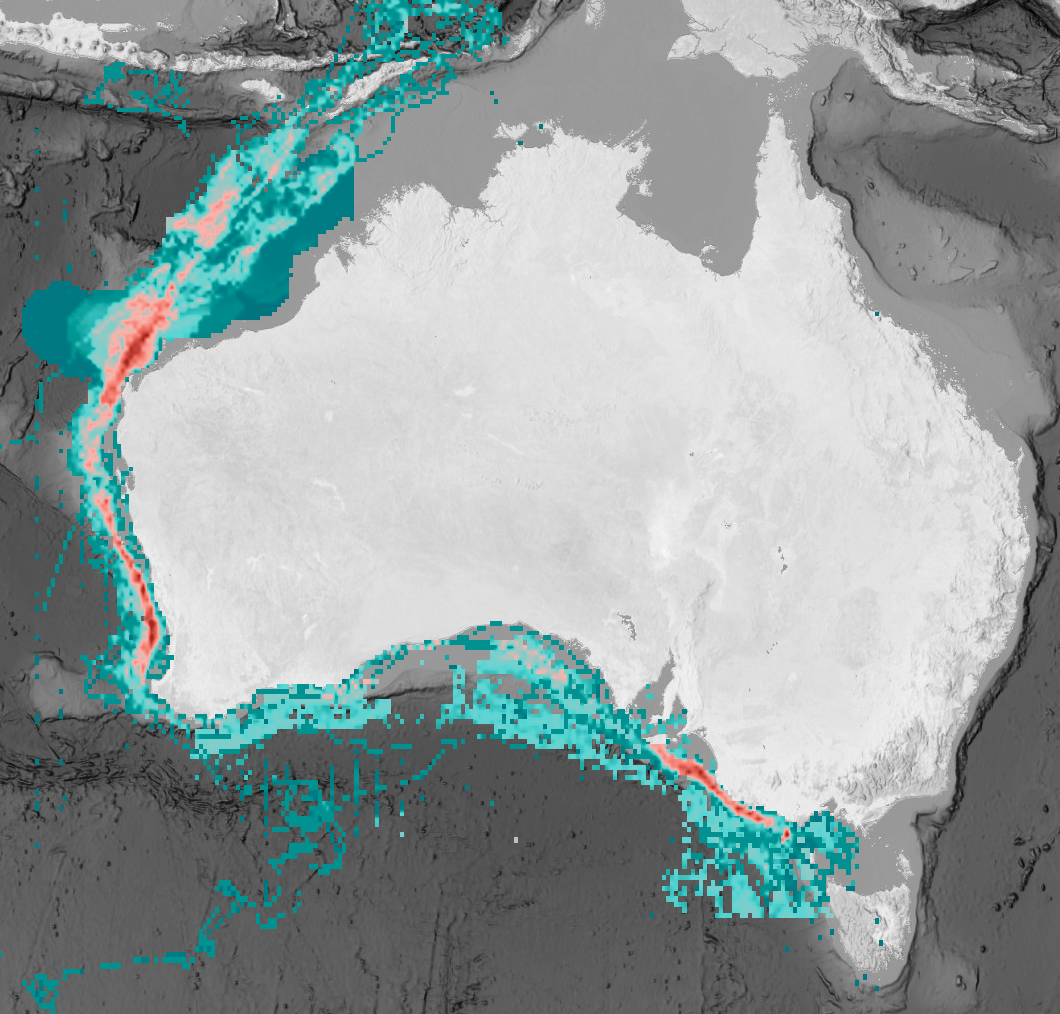
The offshore renewable energy (ORE) sector is rapidly developing in Australian waters to support national carbon emission targets. However, new marine infrastructure can introduce additional risks to threatened species. The eastern Indian Ocean pygmy blue whale (Balaenoptera musculus brevicauda) was identified by the Australian Government as a priority species for assessing potential ORE impacts. This subspecies ranges from the Subtropical Convergence (~40-45°S) to Southeast Asia (~2°S), with much of its documented distribution occurring within Australia’s Exclusive Economic Zone. Its distribution overlaps with multiple anthropogenic activities, indicating likely exposure to existing and emerging pressures. This dataset compiled available spatial information to quantify the full distribution and foraging distribution of pygmy blue whales, and to assess exposure to individual and cumulative threats across the species’ range. The threat exposure analysis incorporated expert elicitation to estimate the probability of exposure arising from spatial overlap between pygmy blue whale distribution and anthropogenic pressures, with particular focus on areas undergoing ORE development. The cumulative exposure assessment indicated relatively low exposure of pygmy blue whales to existing threats within Australian waters, including within declared ORE areas. However, several data and knowledge gaps were identified that should be addressed before further ORE development. The resulting spatial layers provide a baseline for impact assessment by industry and regulators, and support decision-making for sustainable ORE development in Australian waters.
-
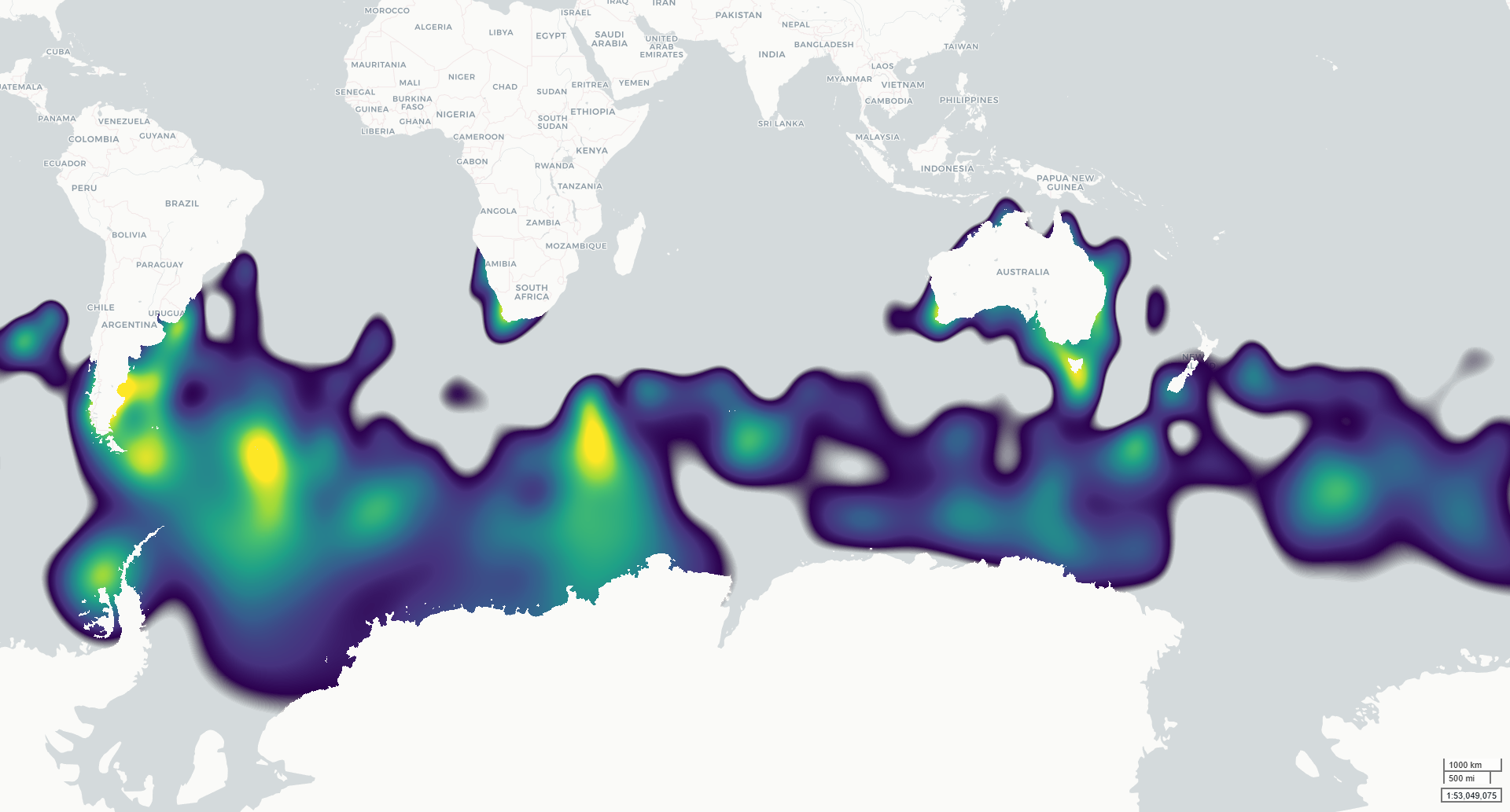
This dataset contains modelled monthly distributions of priority seabirds developed to support assessment of exposure to offshore renewable energy development as part of NESP MaC Project 4.7. Distributions are modelled for six species: Amsterdam Albatross, Gould’s Petrel, Gray-headed Albatross, Northern Royal Albatross, Shy Albatross and Southern Giant Petrel. The underlying project priority species were identified by NOPSEMA and DCCEEW, building on species priorities investigated under NESP MaC Project 3.21. Continuous integrated space-time species distribution models were fitted across the Southern Hemisphere using observations from multiple data types, including tracking, presence-absence, abundance and presence-only records. The outputs describe spatial and seasonal variation in seabird distribution on a 5 km equal-area EASE-Grid 2.0 grid. Two related raster products are provided for each modelled taxon: (1) a normalised population-distribution surface representing the relative proportion of the modelled population within each grid cell; and (2) an estimated population-density surface (individuals per km²) derived by scaling these proportions by the estimated total adult population size (Southern hemisphere). The models were developed to provide spatially and temporally explicit seabird distributions for cumulative risk assessment, including assessment of overlap with offshore renewable energy activities. Monthly outputs describe seasonal patterns across January–December. ***This data is under development. Access to the finalised spatial data will be provided once finalised, estimated early 2027.***
-

This dataset contains modelled monthly migration patterns across Bass Strait for three priority shorebird species: Curlew Sandpiper (Calidris ferruginea), Far Eastern Curlew (Numenius madagascariensis) and Red Knot (Calidris canutus). The species were selected from a suite of priority species identified by NOPSEMA and DCCEEW, building on species priorities investigated under NESP MaC Project 3.21. Modelling for Siberian Sand Plover was not progressed because insufficient records were available from Tasmania. Migration was modelled using BirdFlow, a population-level movement model that infers migration routes, timing and connectivity from weekly relative-abundance distributions. Available telemetry, banding and re-sighting data were used to evaluate and select candidate model configurations. The spatial outputs represent the rate (predicted number of crossings per 1 km grid cell) during each month of an average annual migration cycle. Separate raster products are provided for northward and southward movement, together with combined northward + southward transit surfaces. Values represent transit through a cell rather than occupancy or the number of birds present at a location. A single simulated bird may contribute to multiple cells as it moves across the landscape. The models were developed to support assessment of shorebird exposure to offshore renewable energy development in Bass Strait as part of NESP Hub Project 4.7. The products are intended for comparison of the spatial and seasonal intensity of migratory movement, including movement through and around offshore renewable energy areas. ***This data is under development. Access to the finalised spatial data will be provided once finalised, estimated early 2027.***