 IMAS Metadata Catalogue
GEOMORPHIC LANDFORMS/PROCESSES
Type of resources
Topics
Keywords
Contact for the resource
Provided by
Years
-

This record provides an overview of the NESP Marine and Coastal Hub bridging study - "Characterising natural values and identifying indicators and metrics in South-west Corner Marine Park". For specific data outputs from this project, please see child records associated with this metadata. -------------------- Inventory surveys of Australian Marine Parks (AMPs) provide a broad description of the natural assets that exist in Commonwealth waters. These data can be further explored to identify biological indicators and metrics to cost-effectively monitor the AMPs and inform the AMP Monitoring Evaluation Reporting and Improvement (MERI) system. Historical surveys conducted under the NESP Marine Biodiversity Hub inventoried natural values and ecosystem components in selected AMPs. They developed and tested standardised survey techniques to allows scientists and park managers to identify and measure the status of natural values and ecosystem components. A recent Marine Biodiversity Hub survey conducted detailed bathymetric and visual sampling of key seafloor habitat and fish assemblages in the Capes region of South-west Corner Marine Park (Western Australia). This project analysed the Capes survey data to characterise and predict the broader distribution of natural values and ecosystem features, and to identify relevant indicators of fish and benthic assemblages for Park management. The results are presented alongside summaries of existing knowledge on natural, socio-economic, and cultural values, as well as human pressures. Recommendations include establishing national and international monitoring benchmarks and incorporating survey guidance from Traditional Owners. Outputs • Habitat annotations for AUV & drop camera imagery [dataset] • Habitat map using existing fine-scale bathymetry coverage (validated by drop camera surveys) [dataset] • Annotations of fish and shark size, abundance and diversity from stereo-BRUV deployments [dataset] • Science communication article for the Australian Marine Parks Science Atlas [written] • South-west Corner Marine Park survey report [written]
-
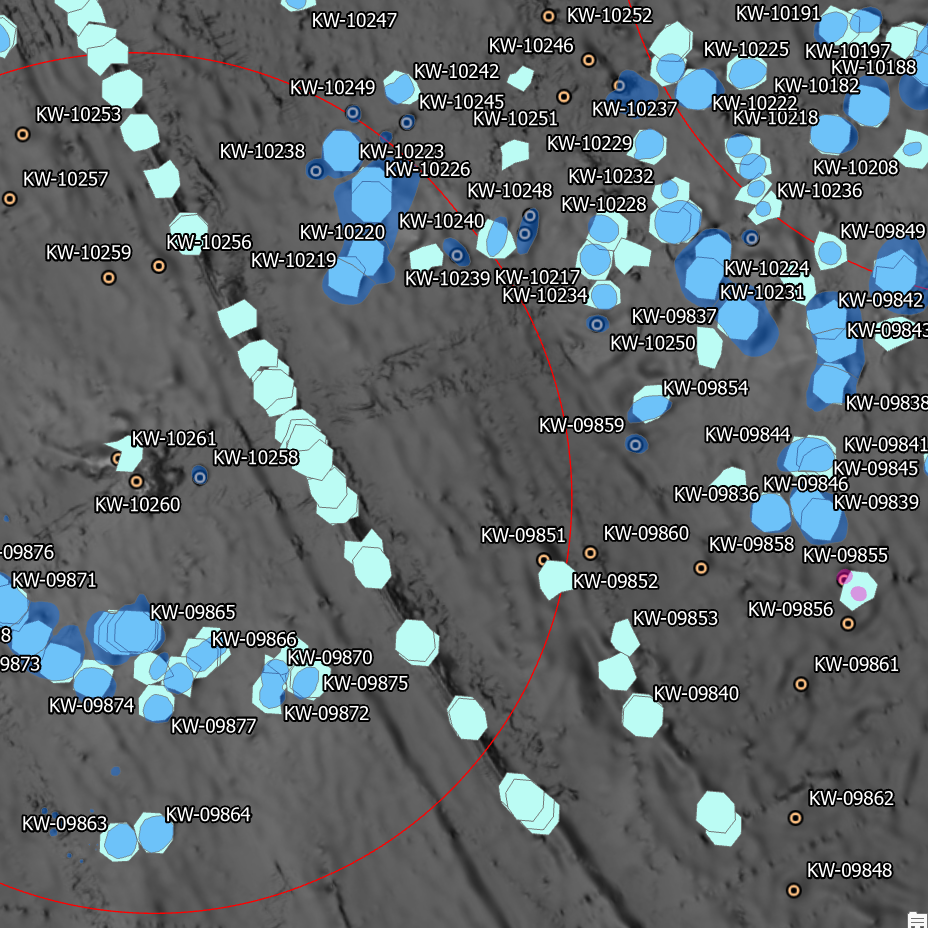
Seamounts, elevated seabed features, and bathymetric highs constitute ecologically significant habitats for various marine species, often associated with unique ecosystems and heightened biodiversity. In Australia, the absence of a comprehensive and spatially accurate inventory of these underwater structures has been a notable gap. Existing broad-scale modelling efforts, including the Parks Australia Natural Values Ecosystems (NVE) map (https://seamapaustralia.org/map/#af207808-481a-4648-93d3-4011f2689461), have predominantly relied on coarse, global datasets. These datasets, characterized by low resolution, often fail to incorporate recent bathymetric data, leading to the omission or incorrect identification of features. This work aimed to address these limitations by developing an improved dataset of raised seabed features, specifically designed to enhance broad-scale modelling efforts like those used in the NVE mapping, and in support of the objectives of NESP Marine and Coastal Hub Project 2.3 (https://www.nespmarinecoastal.edu.au/project/2-3/). Seamount features were extracted from a range of data sources (see 'lineage' section of this record) for the area surrounding the Australian continental margin. These were cross-referenced with GEBCO's 2023 global terrain model (15 arc-second interval grid) and any obviously erroneous features removed. This dataset includes all features located inside the Australian Exclusive Economic Zone (EEZ). Rather than cropping exclusively to this boundary, those features falling outside the Aus EEZ but in the approximate vicinity were also retained for context Existing feature boundaries were redigitised for areas in which more recent high-resolution bathymetry was available, utilising the 'Bathymetry of Australian Marine Parks (2024)' compilation dataset and individual survey datasets available through the AusSeabed data portal (https://portal.ga.gov.au/persona/marine). Where available, fine-scale geomorphic mapping in which seamounts and pinnacles had been classified were extracted and merged with the larger-scale features. If fine-scale mapping disagreed with features classified in the broader-scale datasets, the finer-scale data was prioritised. Where multiple features occurred immediately adjacent to each other, the digitised area represents the "footprint" of the features and as such, a single polygon may encompass multiple peaks. Where features could be uniquely identified (eg by a formal name/title), this attribute is included in the dataset.