 IMAS Metadata Catalogue
East Antarctic Polynyas: Seal data
This collection represents data collected by Sothern Elephant seals in East Antarctica between 2004 and 2009. The monthly dataset has been further classified by polynya and year. An additional polynyas dataset is defined following a criteria of 75% of sea-ice concentration for each individual month between 2004 and 2019. Data are provided in .mat format
Simple
Identification info
- Date (Publication)
- 2023-04-03T00:00:00
Identifier
- Title
- Information and documentation - Digital object identifier system
- Citation identifier
- ISO 26324:2012
- Code
- 10.25959/pba8-0246
- Codespace
- doi.org
- Description
- Digital Object Identifier (DOI)
Principal investigator
Principal investigator
Collaborator
Collaborator
Originator
Collaborator
Collaborator
- Credit
- The seal CTD-SRDL tags and deployment were funded and supported through a collaboration between the French Polar Institute (program 109: PI. H. Weimerskirch and 1201: PI. C. Gilbert and C. Guinet), the SNO-MEMO and CNES-TOSCA and the Integrated Marine Observing System.
- Credit
- The profile data were retrieved from the Marine Mammals Exploring the Oceans Pole to Pole (MEOP) database (http://www.meop.net/), which is a comprehensive quality-controlled database.
- Credit
- This project received grant funding from the Australian Government as part of the Antarctic Science Collaboration Initiative program. The Australian Research Council provided financial support through Discovery Projects DP180101667 and DP210103091. E.P.R is supported under ARC Discovery grant DP180101667 and S.B is supported under ARC DECRA grant DE180100828. The work was supported in part by the Centre for Southern Hemisphere Oceans Research, a partnership between CSIRO, the Qingdao National Laboratory for Marine Science and Technology, the University of New South Wales and the University of Tasmania and by the Australian Antarctic Program Partnership
- Status
- Completed
Author
Institute for Marine and Antarctic Studies - Portela Rodriguez, Esther
University of Tasmania
Tasmania
Australia
- Topic category
-
- Oceans
- Biota
Extent
N
S
E
W
))
Temporal extent
- Time period
- 2004-01-01 2019-12-31
Vertical element
- Minimum value
- 0
- Maximum value
- 1300
- Identifier
- EPSG::5715
- Name
- MSL depth
- Maintenance and update frequency
- Not planned
- Keywords (Theme)
-
- Physical oceanography
- Marine ecology
- Antarctic data
- Antarctic science
- Global Change Master Directory Earth Science Keywords, Version 8.5
- AODN Discovery Parameter Vocabulary
-
- Temperature of the water body
- Practical salinity of the water body
- Mixed Layer Depth
- Stratification (N2)
- Density of the water body
- Longitude
- Latitude
- Seal tag number
- Time
- Polynya's contours
Resource constraints
- Use limitation
- Data, products and services from IMAS are provided "as is" without any warranty as to fitness for a particular purpose.
Resource constraints
- Linkage
-
https://licensebuttons.net/l/by/4.0/88x31.png
License Graphic
- Title
- Creative Commons Attribution 4.0 International License
- Alternate title
- CC-BY
- Edition
- 4.0
- Website
-
https://creativecommons.org/licenses/by/4.0/
License Text
- Other constraints
- Cite data as: Portela Rodriguez, E., Hindell, M., Rintoul, S., Bestley, S., Roquet, F., McMahon, C., Herraiz-Borreguero, L., Harcourt, R., Guinet, C., & van Wijk, E. (2023). East Antarctic Polynyas: Seal data [Dataset]. Institute for Marine and Antarctic Studies. https://doi.org/10.25959/PBA8-0246
- Language
- English
- Character encoding
- UTF8
- Supplemental Information
- Portela, E., Rintoul, S. R., Bestley, S., Herraiz-Borreguero, L., van Wijk, E., McMahon, C. R., et al. (2021). Seasonal transformation and spatial variability of water masses within MacKenzie polynya, Prydz Bay. Journal of Geophysical Research: Oceans, 126(12), 1–21. https://doi.org/10.1029/2021jc017748 Portela, E., Rintoul, S. R., Herraiz‐Borreguero, L., Roquet, F., Bestley, S., Wijk, E. et al., (2022). Controls on Dense Shelf Water Formation in Four East Antarctic Polynyas, Journal of Geophysical Research: Oceans, 127(12). https://doi.org/10.1029/2022JC018804
Content Information
- Content type
- Physical measurement
Identifier
- Identifier
- http://vocab.nerc.ac.uk/collection/P06/current/UPAA
- Name
- Degrees Celsius
Identifier
- Identifier
- http://vocab.aodn.org.au/def/unitsofmeasure/entity/481
- Name
- Practical Salinity Unit
Identifier
- Code
- Mixed Layer Depth
- Identifier
- http://vocab.nerc.ac.uk/collection/P06/current/ULAA
- Name
- Metres
Identifier
- Code
- Stratification (N2)
- Name
- seconds-1
Identifier
- Identifier
- http://vocab.nerc.ac.uk/collection/P06/current/UKMC
- Name
- Kilograms per cubic metre
Identifier
- Code
- Longitude
- Identifier
- http://vocab.nerc.ac.uk/collection/P06/current/UAAA
- Name
- Degrees
Identifier
- Code
- Latitude
- Identifier
- http://vocab.nerc.ac.uk/collection/P06/current/UAAA
- Name
- Degrees
Identifier
- Code
- Seal tag number
- Name
- none
Identifier
- Code
- Time
- Name
- days
Identifier
- Code
- Polynya's contours
- Name
- Longitude/latitude
Distribution Information
- Distribution format
-
- MATLAB format (.mat and .m)
- OnLine resource
- DATA ACCESS - browse all files for download
Resource lineage
- Statement
- The vertical temperature-salinity profiles used in this sdata set were collected by southern elephant seals (Mirounga leonina) instrumented with Conductivity-Temperature-Depth Satellite-Relayed Data Loggers (CTD-SRDLs) during their annual post-molt (February–November) foraging trips. The profile data were retrieved from the Marine Mammals Exploring the Oceans Pole to Pole (MEOP) data- base (http://www.meop.net/). The processing involved in this data set comprises the monthly delimitation of East Antartic polynyas between 2004 and 2019 and the assignation of the data profiles to any of the 18 detected polynyas. We identified polynyas using a combination of dynamic sea-ice concentration and static bathymetric data. First, the whole region was divided into coarse-scale polygons, each one containing one polynya as based on previous descriptions in the literature (Amblas & Dowdeswell, 2018; Arrigo & van Dijken, 2003; Labrousse et al., 2018; Tamura et al., 2016). After this first identification, two criteria were used to define the area of each polynya and to assign seal CTD profiles to them. In winter (from April to October), monthly sea-ice concentration contours of 75% within each polygon were selected and all data inside those contours were assigned to belong to the given polynya. With this method, polynya surface area changes monthly. In summer (from November to March), when most of the region is indeed ice-free, we assigned CTD profiles that were located within the 75% contours of mean sea- ice concentration between April and October of the preceding winter. To avoid including data off the continental shelf, the contours are further constrained by the continental slope (defined by depths<1,500 m).
- Hierarchy level
- Dataset
- Hierarchy level
- Dataset
Metadata
- Metadata identifier
- urn:uuid/e2b60954-29ba-4b9b-89a3-e06377f111ed
- Language
- English
- Character encoding
- UTF8
Distributor
Type of resource
- Resource scope
- Dataset
- Name
- IMAS Dataset level record
- Metadata linkage
-
https://metadata.imas.utas.edu.au/geonetwork/srv/eng/catalog.search#/metadata/e2b60954-29ba-4b9b-89a3-e06377f111ed
Point of truth URL of this metadata record
- Date info (Creation)
- 2023-03-20T00:00:00
- Date info (Revision)
- 2026-10-20T08:42:01
Metadata standard
- Title
- ISO 19115-3:2018
Overviews
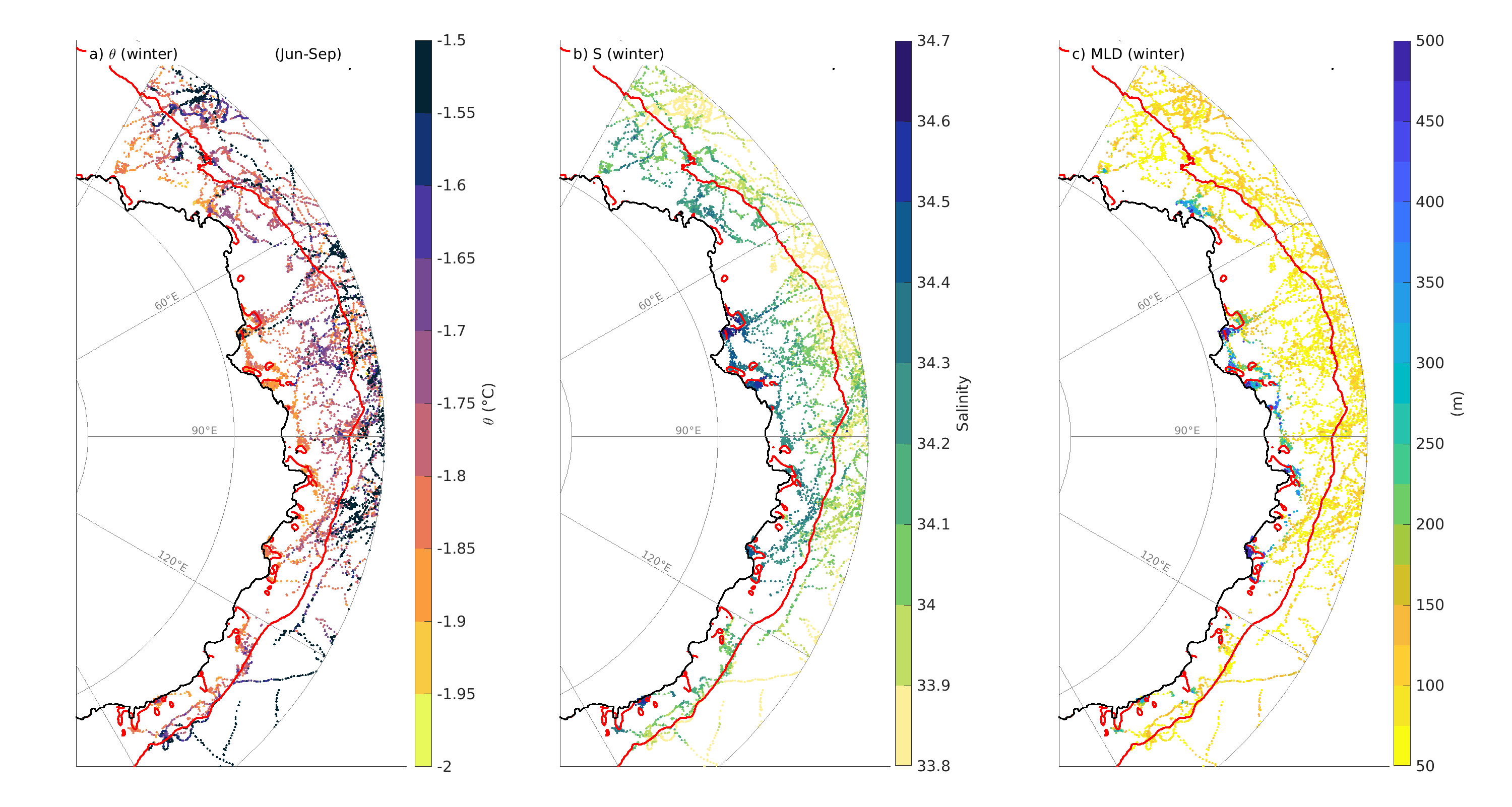
East ACTA overview: winter

East ACTA overview: summer

East ACTA overview: fall
Spatial extent
N
S
E
W
Provided by

Associated resources
Not available