 IMAS Metadata Catalogue
KRILLPODYM modelled estimates of Antarctic krill circumpolar distribution
Robust prediction of population responses to changing environments requires the integration of factors controlling population dynamics with processes affecting distribution. This is true everywhere but especially in polar pelagic environments. Biological cycles for many polar species are synchronised to extreme seasonality, while their distributions may be influenced by both the prevailing oceanic circulation and sea-ice distribution. Antarctic krill (krill, Euphausia superba) is one such species exhibiting a complex life history that is finely tuned to the extreme seasonality of the Southern Ocean. Dependencies on the timing of optimal seasonal conditions has led to concerns over the effects of future climate on krill’s population status, particularly given the species’ important role within Southern Ocean ecosystems.
Under a changing climate, established correlations between environment and species may breakdown. Developing the capacity for predicting krill responses to climate change therefore requires methods that can explicitly consider the interplay between life history, biological conditions, and transport. The Spatial Ecosystem And Population Dynamics Model (SEAPODYM) is one such framework that integrates population and general circulation modelling to simulate the spatial dynamics of key organisms. Here, we describe a modification to SEAPODYM, creating a novel model – KRILLPODYM – that generates spatially resolved estimates of krill biomass and demographics. This new model consists of three major components: (1) an age-structured population consisting of five key life stages, each with multiple age classes, which undergo age-dependent growth and mortality, (2) six key habitats that mediate the production of larvae and life stage survival, and (3) spatial dynamics driven by both the underlying circulation of ocean currents and advection of sea-ice.
Here we present the first results of KRILLPODYM, using published deterministic functions of population processes and habitat suitability rules. Initialising from a non-informative uniform density across the Southern Ocean our model independently develops a circumpolar population distribution of krill that approximates observations. The model framework lends itself to applied experiments aimed at resolving key population parameters, life-stage specific habitat requirements, and dominant transport regimes, ultimately informing sustainable fishery management.
____
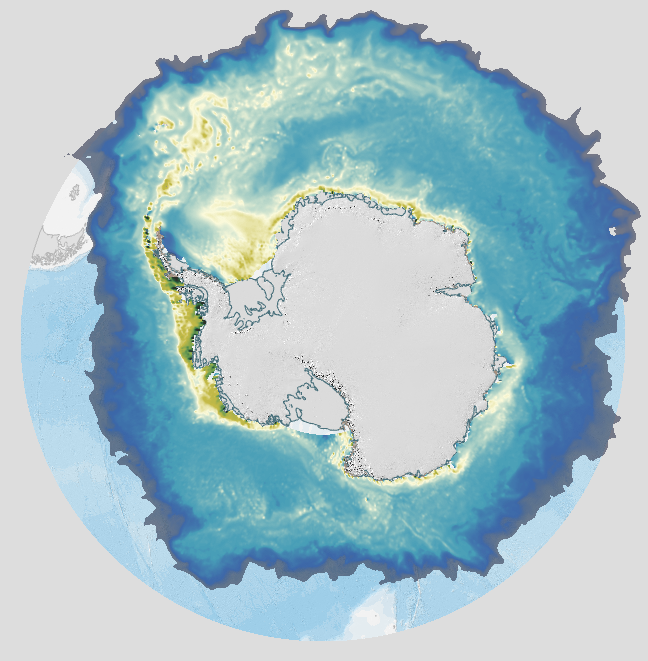
This dataset represents KRILLPODYM modelled estimates of Antarctic krill circumpolar biomass distribution for the final year of a 12-year spin up. Biomass distributions are given for each of the five key life stages outlined above.
The accompanying background, model framework and initialisation description can be found in the following reference paper:
Green DB, Titaud O, Bestley S, Corney SP, Hindell MA, Trebilco R, Conchon A and Lehodey P (2023) KRILLPODYM: a mechanistic, spatially resolved model of Antarctic krill distribution and abundance. Front. Mar. Sci. 10:1218003.
Simple
Identification info
- Date (Publication)
- 2023-06-08T00:00:00
Identifier
- Title
- Information and documentation - Digital object identifier system
- Citation identifier
- ISO 26324:2012
- Code
- 10.25959/895K-K978
- Codespace
- doi.org
- Description
- Digital Object Identifier (DOI)
Principal investigator
- Credit
- This research was supported by the Australian Research Council Special Research Initiative, Australian Centre for Excellence in Antarctic Science (ACEAS) (Project Number SR200100008). DG received funding through a Tasmania Graduate Research Scholarship. SB was supported by the Australian Research Council under DECRA award DE180100828. Further funding was provided through the European H2020 International Cooperation project Mesopelagic Southern Ocean Prey and Predators No 692173.
- Status
- Completed
Point of contact
- Topic category
-
- Biota
- Oceans
Extent
))
Temporal extent
- Time period
- 2023-01-01 2023-12-31
- Maintenance and update frequency
- As needed
- Keywords (Theme)
-
- Southern Ocean
- Ecosystem modelling
- Earth systems
- Population connectivity
- Fisheries
- Mid-trophic pelagic prey
- Spatial processes
- Keywords (Taxon)
-
- Antarctic krill
- Euphausia superba
- Global Change Master Directory Earth Science Keywords, Version 8.5
Resource constraints
- Linkage
-
https://licensebuttons.net/l/by/4.0/88x31.png
License Graphic
- Title
- Creative Commons Attribution 4.0 International License
- Alternate title
- CC-BY
- Edition
- 4.0
- Website
-
https://creativecommons.org/licenses/by/4.0/
License Text
- Other constraints
- Cite data as: Green, D. (2023). KRILLPODYM modelled estimates of Antarctic krill circumpolar distribution [Dataset]. Institute for Marine and Antarctic Studies. https://doi.org/10.25959/895K-K978
- Other constraints
- Data, products and services from IMAS are provided "as is" without any warranty as to fitness for a particular purpose.
- Language
- English
- Character encoding
- UTF8
- Supplemental Information
- Green DB, Titaud O, Bestley S, Corney SP, Hindell MA, Trebilco R, Conchon A and Lehodey P (2023) KRILLPODYM: a mechanistic, spatially resolved model of Antarctic krill distribution and abundance. Front. Mar. Sci. 10:1218003. https://doi.org/10.3389/fmars.2023.1218003
Distribution Information
- Distribution format
-
- NetCDF
- OnLine resource
- DATA ACCESS - all project files (zipped)
- OnLine resource
- DATA ACCESS - browse and selectively download available files
- OnLine resource
-
Associated publication
Green DB, Titaud O, Bestley S, Corney SP, Hindell MA, Trebilco R, Conchon A and Lehodey P (2023) KRILLPODYM: a mechanistic, spatially resolved model of Antarctic krill distribution and abundance. Front. Mar. Sci. 10:1218003.
- OnLine resource
- Explore spatial data in Seamap Antarctica
Resource lineage
- Statement
- A full description of the model background, framework, and implementation can be found in the following paper: Green, D. B., Titaud, O., Bestley, S., Corney, S. P., Hindell, M. A., Trebilco, R., Conchon, A. and Lehodey, P. in review. KRILLPODYM: a mechanistic, spatially resolved model of Antarctic krill distribution and abundance. - Frontiers in Marine Science
- Hierarchy level
- Dataset
Metadata
- Metadata identifier
- urn:uuid/d14f679c-41d0-442f-a080-aa1947cefd6d
- Language
- English
- Character encoding
- UTF8
Type of resource
- Resource scope
- Dataset
- Name
- IMAS Dataset level record
- Metadata linkage
-
https://metadata.imas.utas.edu.au/geonetwork/srv/eng/catalog.search#/metadata/d14f679c-41d0-442f-a080-aa1947cefd6d
Point of truth URL of this metadata record
- Date info (Creation)
- 2023-06-08T00:00:00
- Date info (Revision)
- 2026-11-19T08:03:55
Metadata standard
- Title
- ISO 19115-3:2018
Overviews
Spatial extent
Provided by
