 IMAS Metadata Catalogue
Population genetics of temperate subtidal seagrass beds in Tayaritja Sea Country (Furneaux Group of Islands), Lutruwita (Tasmania) (NESP MaC 3.6)
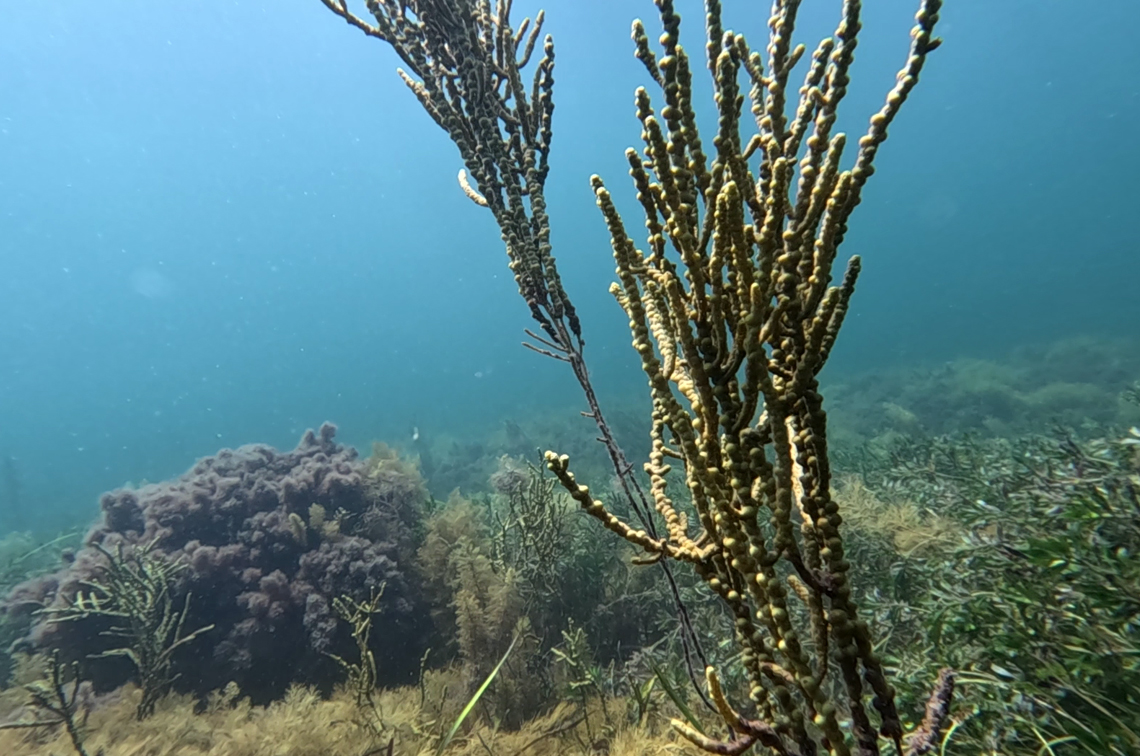
Seagrass beds are a dominant marine ecosystem of Tayaritja (the Furneaux Group of Islands) in the north-eastern waters off Tasmania. Historical coarse mapping has indicated extensive beds of Posidonia, Amphibolis, Heterozostera, and Zostera species, potentially comprising some of the largest and deepest seagrass extents found in temperate Australian waters. However, limited data on the distribution and ecological value of these seagrass habitats represents a significant knowledge gap in understanding Australia's wetland natural assets.
This project mapped the extent, ecological composition, population structure, and blue carbon value of seagrass beds around Tayaritja, in partnership with the Tasmanian Aboriginal Centre. This record specifically describes the seagrass population genetics component of the project.
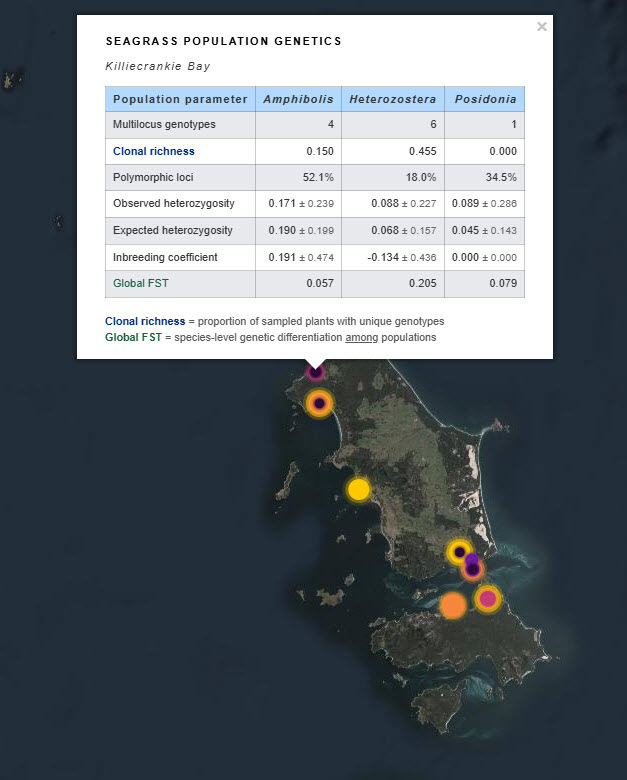
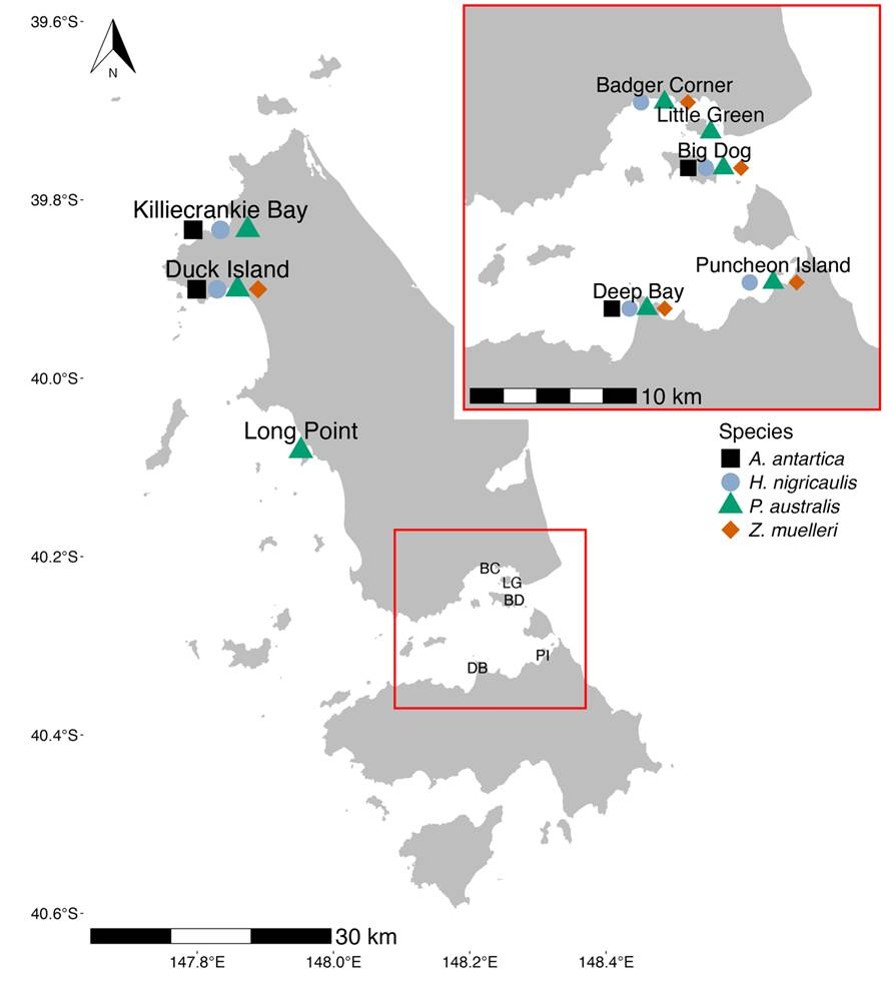
Leaf tissue samples were collected from four seagrass species: Amphibolis antarctica, Heterozostera nigricaulis, Posidonia australis and Zostera muelleri. Samples were collected from multiple sites around Tayaritja Sea Country and processed for genome-wide SNP genotyping using the DArTseq platform. The dataset includes population-level genetic summary statistics, associated DArT metadata and reports, and raw sequence data used to support assessment of genetic diversity, clonality, population structure and connectivity among sampled seagrass populations.
See the "Lineage" section of this record for full methodology.
***EMBARGO NOTE*** Data is currently embargoed until 31/12/2026. Please contact the NESP Data Wrangler (Southern node) to discuss access options: Emma.Flukes@utas.edu.au Emma.Flukes@utas.edu ***EMBARGO NOTE*** Data is currently embargoed until 31/12/2026. Please contact the NESP Data Wrangler (Southern node) to discuss access options: Emma.Flukes@utas.edu.au
Simple
Identification info
- Date (Creation)
- 2026-06-26
Identifier
- Title
- Information and documentation - Digital object identifier system
- Citation identifier
- ISO 26324:2012
- Code
- 10.25959/8AYC-XE17
- Codespace
- doi.org
- Description
- Digital Object Identifier (DOI)
Principal investigator
Collaborator
- Credit
- The data collections described in this record are funded by the Australian Government Department of Climate Change, Energy, the Environment and Water (DCCEEW) through the NESP Marine and Coastal Hub. In addition to NESP (DCCEEW) funding, this project is matched by an equivalent amount of in-kind support and co-investment from project partners and collaborators.
- Status
- Completed
Point of contact
Point of contact
- Topic category
-
- Biota
Extent

Temporal extent
- Time period
- 2024-02-02 2024-02-12
- Maintenance and update frequency
- Not planned
Resource format
- Date
- Keywords (Project)
-
- National Environmental Science Program (NESP) Marine and Coastal Hub
- GCMD Earth science Keywords
- Keywords (Taxon)
-
- Amphibolis antarctica
- Posidonia australis
- Heterozostera nigricaulis
- Zostera muelleri
Resource constraints
- Classification
- Unclassified
Resource constraints
- Other constraints
- This dataset is hosted by the Institute for Marine and Antarctic Studies (IMAS), University of Tasmania, on behalf of NESP Marine and Coastal Hub Project 3.6.
Resource constraints
- Linkage
-
http://i.creativecommons.org/l/by/4.0/88x31.png
License Graphic
- Title
- Creative Commons Attribution 4.0 International License
- Website
-
http://creativecommons.org/licenses/by/4.0/
License Text
- Other constraints
- Cite data as: Sherman, C., Lucieer, V., & Ellis, M. R. (2026). Population genetics of temperate subtidal seagrass beds in Tayaritja Sea Country (Furneaux Group of Islands), Lutruwita (Tasmania) [Dataset]. Institute for Marine and Antarctic Studies. https://doi.org/10.25959/8AYC-XE17
Associated resource
- Title
- Related dataset: Imagery from BOSS and uBRUVs deployed for mapping temperate subtidal seagrass of Tayaritja Sea Country (Furneaux Group of Islands), Lutruwita (Tasmania)
Identifier
- Code
- 10.25959/wrxk-kv06
- Codespace
- doi.org
- Association Type
- Cross reference
Associated resource
- Title
- NESP MaC Project 3.6 - Exploring the distribution and ecological value of seagrass at the Furneaux Islands, Tasmania, 2023-2025 (IMAS, Deakin Uni)
Identifier
- Association Type
- Dependency
- Initiative Type
- Project
- Language
- English
- Character encoding
- UTF8
Distribution Information
- Distribution format
-
- Geotiff
OnLine resource
- Protocol
- https://data.imas.utas.edu.au/attachments/2599078e-77e6-4fdd-9146-3a0ba31242fb
- Name of the resource
- DATA ACCESS - seagrass DArT reports and raw sequence data
- OnLine resource
-
NESP_MaC_3-6_Furneaux_seagrass_genetics
MAP - seagrass population genetics
- OnLine resource
- View data in Seamap Australia
Resource lineage
- Statement
- Leaf tissue samples were collected for genetic analysis from seagrass beds in Tayaritja Sea Country, Flinders Island. Sampling targeted four seagrass species: Amphibolis antarctica, Heterozostera nigricaulis, Posidonia australis and Zostera muelleri. Samples were collected from eight different sites, with 15-25 replicate leaf samples collected within each sampled population. Sampling was undertaken across an approximately 20 m x 20 m area at each site, with a minimum distance of 2 m between samples to reduce the likelihood of repeatedly sampling the same ramet. A subset of samples was selected for DNA extraction and SNP genotyping by Diversity Arrays Technologies Pty Ltd using the DArTseq platform. The resulting SNP data were filtered and analysed in R to assess genetic diversity, clonality and population structure. Multilocus genotypes were identified for each sampled population, and clonal richness was calculated to indicate the proportion of sampled individuals represented by unique genotypes. Population-level summary statistics were derived for each species and sampled population, including numbers of sampled individuals, multilocus genotypes, clonal richness, loci, polymorphic loci, percentage polymorphic loci, observed and expected heterozygosity, inbreeding coefficient and levels of genetic differentiation among populations for each species (global FST). This record provides access to the population-level genetics summary data, DArT metadata and report outputs, and raw sequence data. Further details on laboratory processing, SNP filtering and population genetic analyses are provided in the final project report.
- Hierarchy level
- Dataset
Metadata
- Metadata identifier
- urn:uuid/2599078e-77e6-4fdd-9146-3a0ba31242fb
- Language
- English
- Character encoding
- UTF8
Point of contact
Type of resource
- Resource scope
- Dataset
- Metadata linkage
-
https://metadata.imas.utas.edu.au/geonetwork/srv/eng/catalog.search#/metadata/2599078e-77e6-4fdd-9146-3a0ba31242fb
Point of truth URL of this metadata record
- Date info (Creation)
- 2015-05-06T11:44:25
- Date info (Revision)
- 2026-06-27T10:54:13
Metadata standard
- Title
- ISO 19115-3:2018
Overviews
Spatial extent

Provided by