 IMAS Metadata Catalogue
Neophema chrysogaster
Type of resources
Topics
Keywords
Contact for the resource
Provided by
-
This project undertook a rapid exploration of information on a priority subset of species identified by the Department of Climate Change, Energy, the Environment and Water (DCCEEW) and the National Offshore Petroleum Safety and Environment Authority (NOPSEMA) that are listed as critically endangered or endangered under the Environment Protection and Biodiversity Conservation Act 1999. It specifically focused on these species in relation to the Gippsland declaration area, and the adjacent areas to the declaration area in Bass Strait. This rapid exploration of information was conducted as follows: 1) identify datasets and information sources relevant to priority species identified by DCCEEW and NOPSEMA for the Gippsland declaration area; 2) identify the source of these datasets and information and their level of accessibility; 3) evaluate the utility of datasets and information identified in 2) for assessments/regulatory processes required to be undertaken by DCCEEW and NOPSEMA; and 4) identify what activities would need to be undertaken to improve the accessibility and utility of datasets and information sources identified in 3) that are not currently accessible in useable formats. Fifteen priorities species (12 birds, 3 cetaceans) were identified for which publicly-available occurrence data could be located. This record and the attached download describes the data inventory for Orange-bellied Parrot (Neophema chrysogaster). To download the data inventory for all fifteen priority species, see https://doi.org/10.25959/GB51-RW44.
-
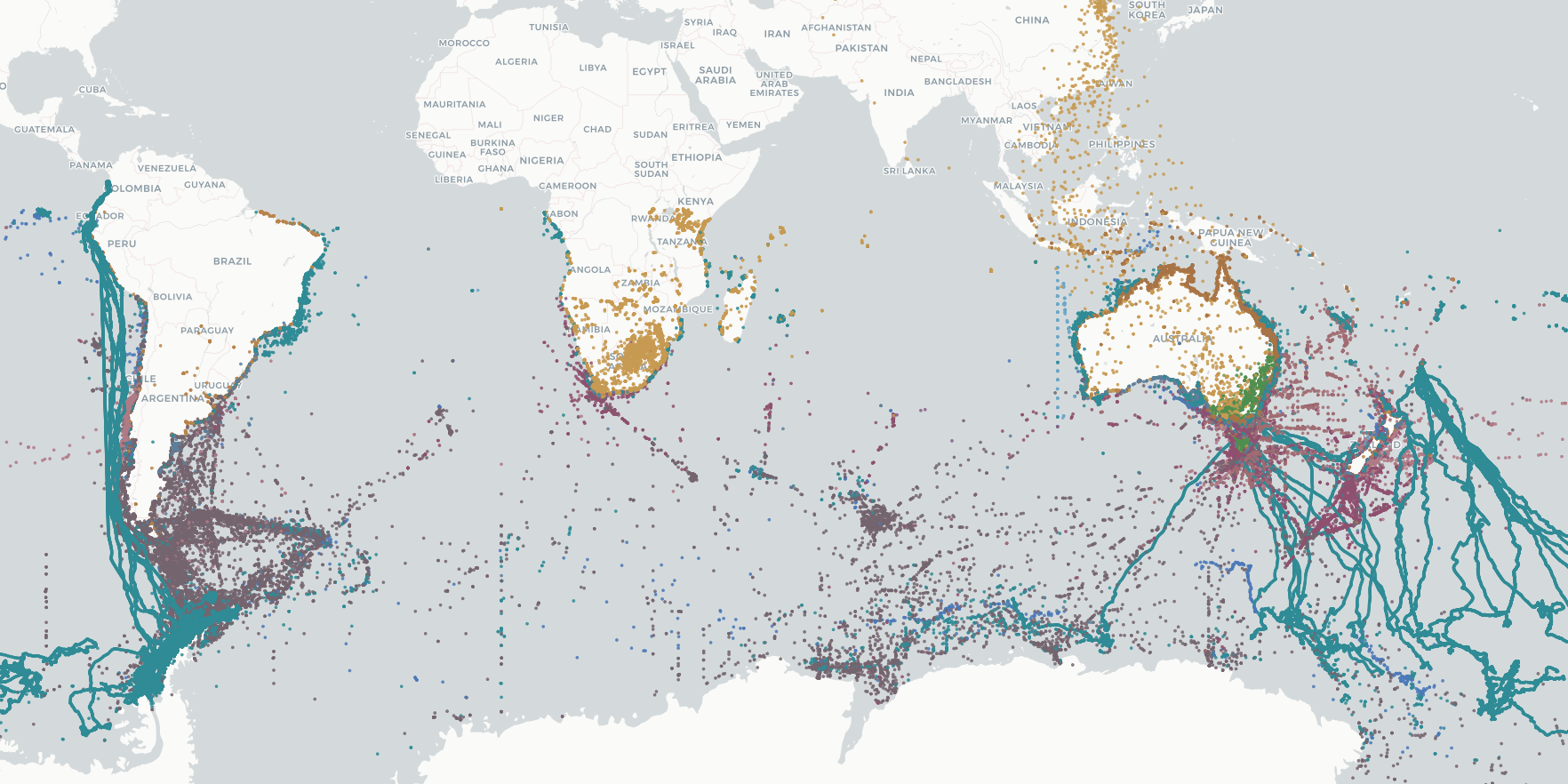
This dataset contains observational records of priority seabird and cetacean species. It is retrieved and processed by an automated data pipeline developed for the ORE TEDISC (Offshore Renewable Energy Trusted Environmental Data and Information Supply Chains) project. Its purpose is to support modelling of potential impacts of the proposed Gippsland offshore wind development on priority marine species in south-east Australia (NESP MaC Project 4.7). Unlike static data compilations, the records are retrieved programmatically through the public APIs of the Atlas of Living Australia (ALA), the Ocean Biodiversity Information System (OBIS), the Global Biodiversity Information Facility (GBIF) and iNaturalist. The pipeline can be re-run to incorporate new records as they become available. Fifteen priority species are included in the dataset, matching those identified for NESP MaC Project 4.7: six albatrosses and petrels (Amsterdam Albatross, Gould’s Petrel, Grey-headed Albatross, Northern Royal Albatross, Shy Albatross and Southern Giant Petrel), four migratory shorebirds (Curlew Sandpiper, Far Eastern Curlew, Siberian Sand Plover and Red Knot), two migratory parrots (Orange-bellied Parrot and Swift Parrot), and three baleen whales (Southern Right Whale, Humpback Whale and Pygmy Blue Whale). Records may also be retrieved under outdated or alternative taxonomic names used by the source repositories. Two related representations of the data are supplied. The first provides source-specific tables that retain records as close to their original form as practical, with processing restricted to the minimum required to parse the source data. A second, combined dataset harmonises records across providers and applies data-quality filtering, taxonomic standardisation and deduplication to produce an observation dataset suitable for use in Species Distribution Models (SDMs). ***This data is under development. Access to the finalised spatial data will be provided once finalised, estimated late 2026.***
-
This project undertook a rapid exploration of information on a priority subset of species identified by the Department of Climate Change, Energy, the Environment and Water (DCCEEW) and the National Offshore Petroleum Safety and Environment Authority (NOPSEMA) that are listed as critically endangered or endangered under the Environment Protection and Biodiversity Conservation Act 1999. It specifically focused on these species in relation to the Gippsland declaration area, and the adjacent areas to the declaration area in Bass Strait. This rapid exploration of information was conducted as follows: 1) identify datasets and information sources relevant to priority species identified by DCCEEW and NOPSEMA for the Gippsland declaration area; 2) identify the source of these datasets and information and their level of accessibility; 3) evaluate the utility of datasets and information identified in 2) for assessments/regulatory processes required to be undertaken by DCCEEW and NOPSEMA; and 4) identify what activities would need to be undertaken to improve the accessibility and utility of datasets and information sources identified in 3) that are not currently accessible in useable formats. Fifteen priorities species (12 birds, 3 cetaceans) were identified for which publicly-available occurrence data could be located: Australian Gould's Petrel (Pterodroma leucoptera leucoptera), Curlew Sandpiper (Calidris ferruginea), Eastern Curlew (Numenius madagascariensis), Grey-headed Albatross (Thalassarche chrysostoma), Mongolian Lesser Sand Plover (Charadrius mongolus), North-Eastern Siberian Red Knot (Calidris canutus), Northern Royal Albatross (Diomedea sanfordi), Orange-bellied Parrot (Neophema chrysogaster), Swift Parrot (Lathamus discolor), Shy Albatross (Thalassarche cauta), Southern Giant Petrel (Macronectes giganteus), Wedge-Tailed Eagle (Aquila audax), Blue Whale (Balaenoptera musculus), Southern Right Whale (Eubalaena australis), Humpback Whale (Megaptera novaeangliae). The data attached to this record outlines the data sources and access points located for each of the species listed above.